


A Charlotte civil litigation lawyer represents individuals and businesses in disputes over contracts, property, business relationships, and money owed, pursued through Mecklenburg County’s civil court system. North Carolina channels civil cases into different courts based on the specific dollar amount at stake, and understanding which court a dispute belongs in, along with the specific legal theory that fits the facts, shapes the entire strategy of a case from the outset. The Watson Law Office offers a case review at (704) 885-5025.
Civil litigation covers an unusually broad range of disputes, from contract disputes between businesses, to other torts causing damages to one or more parties. What unites these cases is not the subject matter but the process: North Carolina’s civil procedure rules, court structure, and specific statutory remedies apply across this range, and knowing how to use them effectively separates a strong claim from a weak one. A dispute that seems purely factual on the surface, such as a disagreement over whether work was completed to specification, often turns as much on which legal theory you pursue and which court you file in as it does on the underlying facts.

North Carolina’s Three-Tier Civil Court System
North Carolina channels civil lawsuits into different courts depending on the amount of money actually at stake, a structure that changed significantly in 2013 when the General Assembly raised the jurisdictional thresholds statewide.
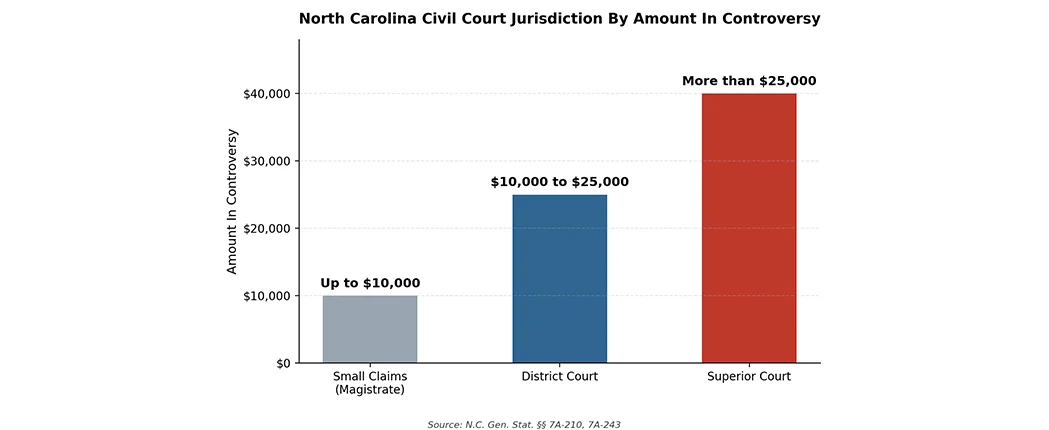
Figure 1. North Carolina civil court jurisdiction by amount in controversy.
Small claims cases, generally $10,000 or less, are heard by a magistrate, an appointed judicial official who does not need to be an attorney. Small claims proceedings are informal, do not require a jury, and commonly involve unpaid debts, property damage, and residential evictions. A magistrate’s decision can be appealed for a completely new trial, called a trial de novo, in District Court. District Court hears cases between $10,000 and $25,000, and cases exceeding $25,000 proceed in Superior Court, which also hears appeals from District Court and includes North Carolina’s specialized Business Court for complex corporate and commercial disputes.
Mecklenburg County sits within North Carolina’s 26th Judicial District, and the Mecklenburg County Courthouse handles civil filings locally. These jurisdictional thresholds were significantly raised by the General Assembly in 2013, when the small claims limit doubled from $5,000, and the District Court ceiling rose from $10,000 to its current $25,000 level, a change that shifted a substantial number of cases that previously would have gone to Superior Court into the District Court division instead.
Source: N.C. Gen. Stat. §§ 7A-210, 7A-243; N.C. Gen. Stat. § 7A-45.4 (Business Court).
North Carolina’s Mandatory Mediation Requirement
Most civil cases filed in Superior Court in North Carolina must go through a mediated settlement conference before trial under North Carolina General Statutes Section 7A-38.1. This means the parties, along with a certified mediator, attempt to resolve the case in a structured, confidential settlement conference before incurring the significant time and expense of trial preparation. While mediation does not guarantee a settlement, and either party can proceed to trial if it fails, the requirement means that a realistic litigation strategy in Charlotte almost always needs to account for this mediation step, not just the eventual possibility of trial.
Source: N.C. Gen. Stat. § 7A-38.1.
Breach Of Contract Claims
A breach of contract claim in North Carolina generally requires proving a valid contract existed, the plaintiff performed its obligations or had a legitimate excuse for not doing so, the defendant breached the contract’s terms, and the breach caused actual damages. Contracts can be written, oral, or partly performed through the parties’ conduct, though written agreements are generally easier to prove and interpret than disputes over verbal promises.
Most breach of contract claims in North Carolina must be filed within three years of the breach, though certain specialized contracts and sealed instruments can carry different deadlines. Remedies for a proven breach typically include compensatory damages designed to put the injured party in the position they would have occupied had the contract been performed, though specific performance, an order requiring the breaching party to actually complete the agreed obligation, is available in certain circumstances, particularly involving real estate or unique goods where money damages would not adequately address the harm.
Consequential damages, losses that flow indirectly from the breach rather than the breach itself, are also sometimes recoverable, though North Carolina generally requires these damages to have been reasonably foreseeable to both parties at the time the contract was formed, which makes the specific language of the agreement, and any communications between the parties about the stakes involved, particularly important evidence.
Source: N.C. Gen. Stat. § 1-52.
The Discovery Process In North Carolina Civil Cases
Once a lawsuit is filed, North Carolina’s Rules of Civil Procedure govern how each side gathers evidence from the other through discovery. This generally includes written interrogatories, requests for production of documents, requests for admission, and depositions, in which a witness answers questions under oath outside of court. Discovery in Superior Court cases, particularly complex business disputes, can be extensive, and how thoroughly a party responds, or fails to respond, to discovery requests can itself become a significant issue in the case, sometimes resulting in court sanctions for a party that withholds evidence improperly.
North Carolina courts have broad authority to compel production of withheld evidence, exclude evidence a party failed to disclose, and in extreme cases, enter judgment against a party that repeatedly disregards its discovery obligations, which makes cooperation with legitimate discovery requests a practical necessity even when a party would prefer to keep certain information confidential.
North Carolina’s discovery rules are similar to, though not identical to, the federal rules many attorneys also know, and cases filed in the specialized Business Court often involve more detailed case management orders governing the pace and scope of discovery than a standard Superior Court case.
Properly preserving evidence as soon as a dispute becomes apparent, well before a lawsuit is even filed, is often critical, since electronic communications, financial records, and other documentary evidence can be lost or overwritten if a preservation obligation is not addressed early. A party who reasonably anticipates litigation has a duty to preserve relevant evidence even before a complaint is formally filed, and failing to do so can result in sanctions later in the case, regardless of whether the loss of evidence was intentional or simply the result of routine business practices continuing unchanged.
Source: North Carolina Rules of Civil Procedure.
Pretrial Motions And Summary Judgment
Many civil cases in North Carolina are resolved, or substantially narrowed, before trial through pretrial motions. A motion to dismiss challenges whether the plaintiff’s complaint, even if every alleged fact is true, states a valid legal claim. A motion for summary judgment, filed after discovery develops the factual record, argues that no genuine dispute of material fact exists and that the moving party is entitled to judgment as a matter of law without a trial.
These motions are often where a case is actually won or lost, particularly in commercial disputes with extensive documentary evidence. A well-supported motion for summary judgment can end a case, or a significant part of it, months or years before a trial date would otherwise be reached, which makes early, thorough case preparation valuable well beyond simply avoiding surprises down the road. A party facing a motion for summary judgment must present specific, admissible evidence supporting its position rather than relying on allegations in its own pleadings, so the discovery process described above directly shapes whether a case survives to trial.
North Carolina’s Unfair And Deceptive Trade Practices Act
One of the most powerful tools in North Carolina civil litigation is the Unfair and Deceptive Trade Practices Act, codified at North Carolina General Statutes Section 75-1.1, which makes it unlawful to engage in unfair or deceptive acts or practices in or affecting commerce. Under the test North Carolina courts apply, established in Dalton v. Camp, a claimant must show that the opposing party committed an unfair or deceptive act, that the act was in or affecting commerce, and that the act proximately caused injury.
North Carolina courts have applied this standard to a remarkably wide range of business conduct over the decades, from deceptive sales practices to breaches of contract accompanied by dishonest conduct, which helps explain why this statute plays such an outsized role in Charlotte commercial litigation compared to an ordinary breach of contract claim standing alone.
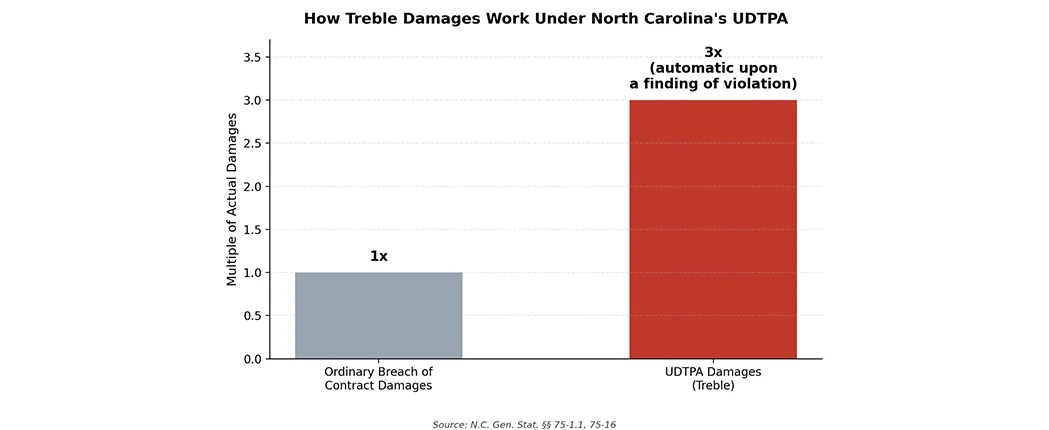
Figure 2. How North Carolina’s Unfair and Deceptive Trade Practices Act multiplies a damages award.
What makes this statute so significant is its remedy structure. Under North Carolina General Statutes Section 75-16, a proven violation results in treble damages, meaning the court automatically multiplies the actual damages award by three once a violation is found, without requiring a separate showing of bad faith. The North Carolina Supreme Court confirmed in Marshall v. Miller that bad faith is not a required element of a claim under this statute. Under Section 75-16.1, a court may also award reasonable attorney’s fees when the violating conduct was willful, or when the losing party unreasonably refused to fully resolve a claim for which the statute provided a remedy.
Because proof of common law fraud automatically qualifies as a violation of this statute under North Carolina case law, many fraud-based business disputes in Charlotte are pursued as UDTPA claims to access this treble-damages remedy. This is one of the most consequential procedural choices available to a plaintiff’s counsel in a Charlotte commercial dispute, since the difference between recovering actual damages alone and recovering three times that amount, plus attorney’s fees, can transform the entire economics of whether a case is worth pursuing and how quickly the other side is willing to settle.
Source: N.C. Gen. Stat. §§ 75-1.1, 75-16, 75-16.1; Dalton v. Camp, 353 N.C. 647 (2001); Marshall v. Miller, 302 N.C. 539 (1981).
This statute has real limits. North Carolina courts have held that private individuals selling their own residence, for example, are not engaged in trade or commerce and generally cannot be sued under this statute, even if they misrepresented the condition of the property, though the real estate professionals involved in that same transaction may still be covered.
Business Torts And Commercial Disputes
- Breach of fiduciary duty, when a business partner, officer, or agent violates a duty of loyalty or care owed to the business or its owners
- Tortious interference with contract, when a third party wrongfully induces a party to breach an existing agreement
- Tortious interference with prospective economic advantage, when wrongful conduct prevents a business relationship from forming in the first place
- Civil conspiracy, when two or more parties agree to accomplish an unlawful act or a lawful act by unlawful means
- Shareholder and LLC member disputes, including claims for oppression of a minority owner or improper distribution of company assets
These business tort claims frequently overlap with a breach of contract or UDTPA claim arising from the same underlying facts, and North Carolina procedure generally allows a plaintiff to plead multiple, even inconsistent, legal theories in the same lawsuit, leaving the ultimate choice of remedy to be sorted out as the case develops.
Breach Of Fiduciary Duty In Detail
A fiduciary relationship arises when one party places special trust and confidence in another, who in turn accepts a duty to act in the other’s best interest, a relationship that commonly exists between business partners, corporate officers and their companies, and majority owners and minority shareholders.
A breach occurs when the fiduciary places their own interests ahead of those they owe a duty to, such as diverting a corporate business opportunity for personal gain or using confidential company information for a competing venture. Because these disputes often unfold behind closed doors, financial records, corporate communications, and other internal documentation typically become central evidence in proving what actually happened.
Business partners who suspect a fiduciary breach often benefit from consulting an attorney before confronting the other party directly, since premature accusations can sometimes give the suspected wrongdoer an opportunity to alter or destroy the very records that would otherwise prove the claim.
Tortious Interference Claims In Detail
A tortious interference with contract claim requires showing that a valid contract existed between the plaintiff and a third party, that the defendant knew about the contract, that the defendant intentionally induced the third party to breach it without justification, and that the plaintiff suffered damages as a result.


A related claim, tortious interference with prospective economic advantage, applies even before a contract exists and protects a business relationship that was reasonably likely to form absent the defendant’s wrongful interference. Competitors in the Charlotte business community sometimes cross the line from aggressive, lawful competition into actionable interference, particularly when false statements to a customer or vendor are involved rather than simply offering a better deal.
Multiple Defendants And Piercing The Corporate Veil
Business litigation in Charlotte frequently involves more than one potential defendant, and identifying every responsible party can matter considerably to what compensation is actually collectible at the end of a case. When a business entity itself has insufficient assets to satisfy a judgment, North Carolina law allows, in limited circumstances, a court to disregard the corporate or LLC structure and hold an individual owner personally liable, a remedy known as piercing the corporate veil. Courts generally require a showing that the entity was so dominated by an individual that it had no separate identity of its own, and that the individual used that domination to commit fraud or a fundamentally unfair act.
Courts apply this remedy narrowly because respecting the limited liability a properly maintained corporation or LLC provides is an important principle of North Carolina business law, but it remains a key consideration when a judgment against a thinly capitalized business entity might otherwise prove worthless.
The Appeals Process In North Carolina Civil Cases
A party unhappy with a Superior Court civil judgment generally has the right to appeal to the North Carolina Court of Appeals, and in certain cases, may seek further review from the North Carolina Supreme Court. Unlike a trial, an appeal does not involve new evidence or witnesses. Instead, it is limited to reviewing the trial court’s record for legal errors, such as an incorrect jury instruction, an improperly admitted piece of evidence, or a legal ruling that misapplied North Carolina law to the facts of the case.
Appellate courts generally give substantial deference to a jury’s factual findings and a trial judge’s discretionary rulings, reserving reversal for genuine legal mistakes rather than simply a different view of how the evidence should have come out.
Appeals operate under strict, often short deadlines, and missing a filing deadline can permanently forfeit the right to challenge an otherwise appealable error. Because an appeal focuses narrowly on legal error rather than simply disagreement with the outcome, identifying genuinely appealable issues and properly preserving them by objecting at the right moments during the trial court proceedings often matters more to the success of an eventual appeal than the underlying facts of the case.
Construction And Contractor Disputes
Charlotte’s ongoing growth has made construction and contractor disputes a recurring category of civil litigation, covering everything from residential remodeling disagreements to large-scale commercial building defects. These cases often combine a straightforward breach of contract claim with additional theories, including negligence for defective workmanship and, in cases involving misrepresentation about materials, licensing, or scope of work, a potential Unfair and Deceptive Trade Practices Act claim against a contractor engaged in trade or commerce.
Homeowners undertaking major renovation projects and commercial developers overseeing large-scale builds face many of the same underlying legal issues, though the dollar amounts and complexity of the contracting relationships often differ considerably between residential and commercial projects.
North Carolina also recognizes mechanics’ liens, a legal claim a contractor, subcontractor, or supplier can file against real property when it has not been paid for labor or materials that improved the property. These liens attach to the property itself, giving an unpaid contractor a form of security beyond simply suing the property owner personally, though strict statutory deadlines and notice requirements apply to preserving lien rights, making prompt action essential once a payment dispute arises on a construction project.
A subcontractor who supplied labor or materials but has no direct contract with the property owner generally has a separate, and in some ways more complicated, path to asserting a lien than a general contractor working directly for the owner, which makes correctly identifying every party in the contracting chain an important early step in any Charlotte construction payment dispute.
Common Types Of Civil Litigation Matters We Handle In Charlotte
- Breach of contract disputes between individuals and businesses
- Claims under North Carolina’s Unfair and Deceptive Trade Practices Act
- Trade secret and non-compete disputes
- Severance Agreements
- Small claims
- Fraud and misrepresentation claims
Common Myths About Civil Litigation Versus North Carolina Law
| Common Myth | The Legal Reality In North Carolina |
| Any dispute over a few thousand dollars has to go through a full trial | Claims of $10,000 or less are generally handled through small claims court, a faster, more informal process before a magistrate rather than a judge |
| I only get my actual losses back if I win a business dispute | Claims properly brought under the Unfair and Deceptive Trade Practices Act result in automatic treble damages, tripling the actual damages award, plus possible attorney’s fees |
| Winning a lawsuit means I automatically get paid | A judgment is only the first step; collecting on it often requires separate legal action such as garnishment, property liens, or execution against non-exempt assets |
Frequently Asked Questions
Common Concerns Before Calling A Civil Litigation Lawyer
My Dispute Seems Too Small To Bother With A Lawyer
Even claims eligible for small claims court can benefit from legal guidance, particularly in understanding what evidence you need and what defenses the other side is likely to raise. A brief consultation can clarify whether your situation is worth pursuing formally, and understanding your case’s strength before filing can save considerable time and expense compared to discovering weaknesses only after a hearing has begun.
I Do Not Have A Written Contract
An enforceable contract does not always have to be in writing. Oral agreements and the parties’ conduct can establish a contract’s existence and terms, though proving exactly what was agreed to becomes harder without documentation.


The Other Side Has More Resources Than I Do
North Carolina’s procedural rules, including mandatory mediation and cost-shifting remedies like the Unfair and Deceptive Trade Practices Act’s attorney’s fee provision, exist in part to make litigation viable for parties facing a better-resourced opponent. A thorough case evaluation can clarify what leverage you actually have.
What Happens When You Call The Watson Law Office
When you call (704) 885-5025, a member of The Watson Law Office team will ask about your dispute, the amount involved, and any documentation you already have, such as a contract, invoices, or correspondence with the other party. This conversation is free and carries no obligation. If your case is a good fit, you will be scheduled for a consultation with Attorney Kyle T. Watson, who can help you understand which court your case belongs in and what legal theories and remedies may apply to your specific situation. Bring copies of any relevant contracts, financial records, or communications that document the dispute so the consultation can move directly into evaluating your options and the realistic timeline for resolving your case.
If you are facing a contract dispute, business conflict, or property claim in Charlotte, do not assume your options before you understand how North Carolina’s civil litigation system actually works. Call (704) 885-5025 today for a free, no-obligation case review.
