


A Charlotte employment lawyer represents workers facing discrimination, retaliation, unpaid wages, and wrongful termination in Mecklenburg County workplaces, working to hold employers accountable under both North Carolina and federal law. North Carolina is an at-will employment state, which gives employers broad latitude to end a job at any time, but that latitude is not unlimited, and specific statutes and court-recognized exceptions protect employees from the most serious abuses of that power. The Watson Law Office offers a case review at (704) 885-5025.
Employment law in North Carolina combines a strong general presumption in favor of employer discretion with a patchwork of specific statutory protections layered on top. Understanding where that general presumption ends and a specific legal protection begins is the central question in almost every Charlotte employment case, and getting that analysis right early often determines whether a difficult situation at work becomes a viable legal claim.

North Carolina’s At-Will Employment Rule, And Its Limits
North Carolina has long followed the employment-at-will doctrine, under which an employee without a definite-term contract may be terminated by either party at any time, for any reason or no reason at all, so long as the reason is not unlawful. This baseline rule, confirmed by the North Carolina Supreme Court in Still v. Lance in 1971, remains the starting point for every employment relationship in the state that does not involve a specific employment contract.
In 1989, the North Carolina Supreme Court recognized a significant limit on this rule in Coman v. Thomas Manufacturing Co. Coman was a truck driver fired after he refused his employer’s demand that he violate federal Department of Transportation regulations by driving excessive hours and falsifying his logs.
The Court held that North Carolina’s at-will doctrine does not protect an employer that fires a worker for refusing to break the law or for a reason that otherwise violates a well-established public policy of the state. North Carolina courts have since applied this public policy exception in a range of circumstances, including firing workers for refusing to accept pay below minimum wage in Amos v. Oakdale Knitting Co., and courts have confirmed that this common law claim can proceed even where a separate statutory remedy also exists.
Source: Still v. Lance, 279 N.C. 254 (1971); Coman v. Thomas Manufacturing Co., 325 N.C. 172 (1989); Amos v. Oakdale Knitting Co., 331 N.C. 348 (1992).
Courts applying the public policy exception generally ask two questions: whether the employer’s conduct violated a clearly established public policy of North Carolina, and whether a specific statute actually provides that policy without also creating its own private lawsuit remedy.
This second question matters enormously for discrimination claims, discussed in more detail below, because North Carolina’s anti-discrimination statute does not create a standalone private right of action, which is why the public policy exception has become such an important tool in North Carolina discrimination cases. North Carolina courts have described these public policy exceptions as developing case by case rather than through any single, fixed list, meaning new factual patterns continue to be evaluated against the same basic framework as they arise.
North Carolina’s Equal Employment Practices Act
The North Carolina Equal Employment Practices Act, codified at North Carolina General Statutes Section 143-422.2, declares it the public policy of North Carolina to protect employees from discrimination based on race, religion, color, national origin, age, sex, or disability. Unlike the parallel federal protections under Title VII of the Civil Rights Act, the Age Discrimination in Employment Act, and the Americans with Disabilities Act, North Carolina’s statute does not create a separate civil cause of action a worker can file directly.
Instead, North Carolina courts have used this statute as the public policy foundation for a Coman wrongful discharge claim, allowing a worker to sue in state court for a discriminatory firing by combining the public policy declared in Section 143-422.2 with the common law wrongful discharge theory.
Federal discrimination claims, by contrast, generally must first be filed as a formal charge with the Equal Employment Opportunity Commission before a lawsuit can proceed, and that charge must generally be filed within 180 days of the discriminatory act in North Carolina. This dual-track structure, a state common law claim running alongside a federal administrative and litigation process, means a Charlotte discrimination case often benefits from pursuing both avenues rather than treating them as mutually exclusive options.
Source: N.C. Gen. Stat. § 143-422.2.
Sexual Harassment And Hostile Work Environment Claims
Sexual harassment claims in the workplace generally fall into one of two categories under federal law, both of which North Carolina courts and the EEOC recognize. Quid pro quo harassment occurs when a job benefit, such as a promotion, raise, or continued employment, is conditioned on submitting to unwelcome sexual advances.
Hostile work environment harassment occurs when unwelcome conduct based on sex becomes so severe or pervasive that it alters the conditions of employment and creates an abusive working environment, judged both from the perspective of a reasonable person and the actual victim. Charlotte’s rapidly growing corporate and banking sector, with large employers across a range of industries, means these claims arise in workplaces ranging from small local businesses to some of the largest financial institutions headquartered in the region.
An employer’s liability for a supervisor-created hostile work environment often depends on whether the employer took reasonable steps to prevent and promptly correct harassing behavior, and whether the employee unreasonably failed to use preventive or corrective opportunities the employer provided, such as an internal complaint procedure.
This means how a complaint was made and documented often becomes as important as the underlying harassment itself. A single severe incident, such as a sexual assault, can be sufficient to establish a hostile work environment claim even without a pattern of repeated conduct. Harassment based on sex is not limited to conduct between people of different sexes, and it does not require the harasser to be motivated by sexual desire, since demeaning or hostile conduct because of someone’s sex can support a claim on its own.
Disability Discrimination And The Duty To Accommodate
The Americans with Disabilities Act requires covered employers to provide reasonable accommodations to qualified employees with disabilities, unless doing so would impose an undue hardship on the business. A reasonable accommodation might include modified work schedules, additional unpaid leave beyond what other policies provide, reassignment to a vacant position, or physical workplace modifications.
Once an employee requests an accommodation, or an employer otherwise becomes aware that one may be needed, the law generally requires an interactive process a good-faith, back-and-forth conversation between employer and employee to identify an accommodation that could work, rather than an employer simply denying the request outright. This process does not require an employer to grant the specific accommodation an employee prefers, only to genuinely engage in identifying an effective option; a reasonable but different accommodation offered by the employer can still satisfy the law even when it is not the employee’s first choice.
An employer that fails to engage in this interactive process in good faith, or that denies an accommodation without a genuine undue hardship analysis, can face liability even without any other discriminatory motive. Charlotte employees are sometimes told an accommodation is simply against company policy without ever being told the specific business reason a particular accommodation would be an undue hardship, which is itself a sign the interactive process may not have been properly followed.
Documenting each accommodation request in writing, along with the employer’s specific response, is one of the most useful things an employee can do if a disability accommodation dispute later becomes a legal claim.
Source: Americans with Disabilities Act, 42 U.S.C. § 12111 et seq.
The Family And Medical Leave Act
The federal Family and Medical Leave Act provides eligible employees at covered employers with up to 12 weeks of unpaid, job-protected leave per 12-month period for specific family and medical reasons, including a serious personal health condition, the birth or adoption of a child, or caring for a spouse, child, or parent with a serious health condition.
Eligibility requires meeting three separate conditions: the employee must have worked for the employer for at least 12 months, must have worked at least 1,250 hours during the 12 months immediately before the leave begins, and must work at a location where the employer has at least 50 employees within 75 miles. The 12 months of employment do not need to be consecutive, though employment before a gap of seven years or more generally does not count toward this requirement.
An employer that interferes with an employee’s FMLA rights, retaliates against an employee for requesting or taking leave, or fails to reinstate an employee to the same or an equivalent position afterward can face liability independent of any other discrimination claim. Because FMLA eligibility itself depends on specific, sometimes disputed facts, such as exactly how many hours were worked or how many employees work within 75 miles of a specific location, these threshold questions are often contested before the merits of a denial-of-leave claim are even reached.
Source: Family and Medical Leave Act, 29 U.S.C. § 2611 et seq.
Overtime, Minimum Wage, And Employee Misclassification
The federal Fair Labor Standards Act generally requires covered employers to pay non-exempt employees one and one-half times their regular rate for hours worked beyond 40 in a workweek. Whether an employee is properly classified as exempt from overtime depends on specific salary and job duties tests, not simply on a job title or whether an employer labels a position salaried. Executive, administrative, and professional employees can be exempt only if they meet detailed criteria regarding both their compensation level and the actual substance of their job duties.
A related and increasingly common issue is the misclassification of employees as independent contractors. An employer that treats a worker as a contractor when that worker is functionally an employee, based on factors like the degree of control the employer exercises and the worker’s economic dependence on the business, can be liable for unpaid overtime, unpaid minimum wage, and associated penalties under both federal law and North Carolina’s own Wage and Hour Act. Misclassification disputes frequently arise in industries with heavy reliance on contract and gig-style labor arrangements throughout the Charlotte area. Reviewing pay stubs, tax documentation, and the actual day-to-day working relationship, rather than relying on the label used in a hiring agreement, is usually the first step in evaluating whether a misclassification has occurred.
Source: Fair Labor Standards Act, 29 U.S.C. § 201 et seq.
Pregnancy Discrimination And Accommodation
Pregnant employees in Charlotte are protected under multiple overlapping laws. Title VII’s Pregnancy Discrimination Act prohibits treating an employee unfavorably because of pregnancy, childbirth, or related medical conditions. The federal Pregnant Workers Fairness Act, which took effect in 2023, goes further, requiring covered employers to provide reasonable accommodations for pregnancy, childbirth, and related medical conditions, similar to the accommodation obligations that already exist under the Americans with Disabilities Act, unless the accommodation would impose an undue hardship on the business. This is a meaningful expansion of employee rights, since it does not require a pregnancy-related condition to independently qualify as a disability before an accommodation obligation arises.
This means an employer may need to provide accommodations such as additional bathroom breaks, temporary light duty, or schedule adjustments during pregnancy, even for conditions that might not otherwise qualify as a disability under the ADA. An employer that denies a reasonable pregnancy-related accommodation, or that pushes a pregnant employee out of the workplace rather than accommodating her, can face liability separate from any claim of outright pregnancy-based termination.
Source: Pregnancy Discrimination Act, 42 U.S.C. § 2000e(k); Pregnant Workers Fairness Act, 42 U.S.C. § 2000gg et seq.
Age And National Origin Discrimination
The federal Age Discrimination in Employment Act protects workers age 40 and older from discrimination in hiring, firing, promotion, and other terms of employment. Age discrimination claims often present differently than other forms of discrimination, since employers rarely state age as an explicit reason for an adverse decision. Evidence such as a pattern of replacing older workers with significantly younger employees, age-related comments from supervisors, or inconsistent application of performance standards to older workers can all support a claim even without an explicit admission.
A round of layoffs described as eliminating positions rather than people can still support an age discrimination claim if the actual pattern of who lost their job skews heavily toward older employees compared to the workforce as a whole.


National origin discrimination, prohibited under both Title VII and North Carolina’s Equal Employment Practices Act, covers adverse treatment based on a person’s place of birth, ancestry, culture, or accent, and can include English-only workplace policies that are not justified by a genuine business necessity.
Charlotte’s diverse and growing workforce makes national origin claims a recurring employment dispute, particularly involving language-based policies and assumptions about an employee’s communication abilities that are not tied to job performance. A policy requiring English only during specific safety-critical tasks may be defensible, while a blanket rule restricting any other language, even during breaks or casual conversation, is far more likely to draw scrutiny as pretext for discrimination than a genuine business need.
Source: Age Discrimination in Employment Act, 29 U.S.C. § 621 et seq.; N.C. Gen. Stat. § 143-422.2.
The Retaliatory Employment Discrimination Act
North Carolina’s Retaliatory Employment Discrimination Act, commonly called REDA and codified at North Carolina General Statutes Sections 95-240 through 95-245, protects employees from being fired, demoted, suspended, or otherwise punished for engaging in good faith protected activity under a specific list of North Carolina statutes. Protected activity under REDA includes filing or threatening to file a workers’ compensation claim, reporting a wage and hour violation, raising an occupational safety and health complaint, and exercising rights under several other enumerated North Carolina labor statutes.
| Protected Activity | Underlying Statute |
| Filing or pursuing a workers’ compensation claim | N.C. Gen. Stat. Chapter 97 |
| Reporting a wage and hour violation | N.C. Gen. Stat. §§ 95-25.1 to 95-25.25 |
| Raising an occupational safety and health complaint | N.C. Gen. Stat. §§ 95-126 to 95-160 |
| Reporting a mine safety and health violation | N.C. Gen. Stat. §§ 74-24.1 to 74-24.20 |
A REDA complaint must be filed with the North Carolina Commissioner of Labor within 180 days of the alleged retaliation. The Commissioner then investigates and either files a civil action on the employee’s behalf or issues a right-to-sue letter allowing the employee to bring a private lawsuit. North Carolina law also builds in a specific defense for employers: an employer is not liable under REDA if it proves, by the greater weight of the evidence, that it would have taken the same adverse action even without the employee’s protected activity, which makes the surrounding timeline and documented business justification for a termination central to how these cases are actually litigated.
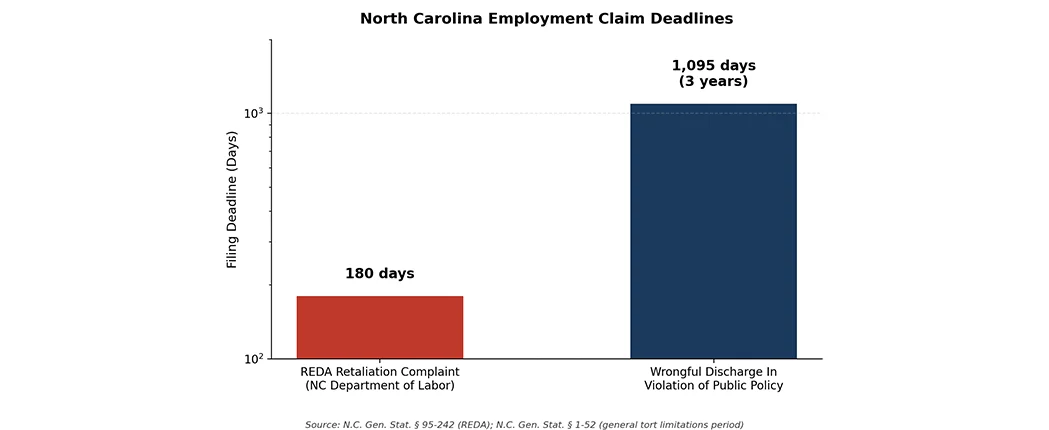
Figure 1. North Carolina employment claim deadlines: REDA retaliation complaints versus a common law wrongful discharge claim.
REDA was substantially amended effective June 22, 2026, under Session Law 2026-13, which specifies new required content for complaints, adds procedural obligations for employees filing them, and for the first time authorizes employers to submit a formal position statement during the Commissioner’s investigation. Employees considering a REDA complaint after that date should know the filing process now includes more formal procedural requirements than before.
Source: N.C. Gen. Stat. §§ 95-240 to 95-245; Session Law 2026-13.
Getting Paid What You Are Owed: The North Carolina Wage And Hour Act
The North Carolina Wage and Hour Act, codified at North Carolina General Statutes Sections 95-25.1 through 95-25.25, governs how and when employers must pay wages, including specific rules for what happens when employment ends. Under Section 95-25.7, an employee whose employment ends for any reason, whether through termination or resignation, must be paid all wages due on or before the next regular payday. Wages based on commissions, bonuses, or other calculations that are not yet finalized at separation must be paid on the first regular payday after the amount becomes calculable.
Accrued vacation pay and similar benefits count as wages under North Carolina law only where the employer has an established policy or practice of paying them, and once earned, those wages cannot be forfeited unless the employer previously gave the employee written notice of a forfeiture policy, under the notice requirements in Section 95-25.13. An employer who fails to properly notify an employee of such a policy cannot rely on it to withhold earned vacation pay.
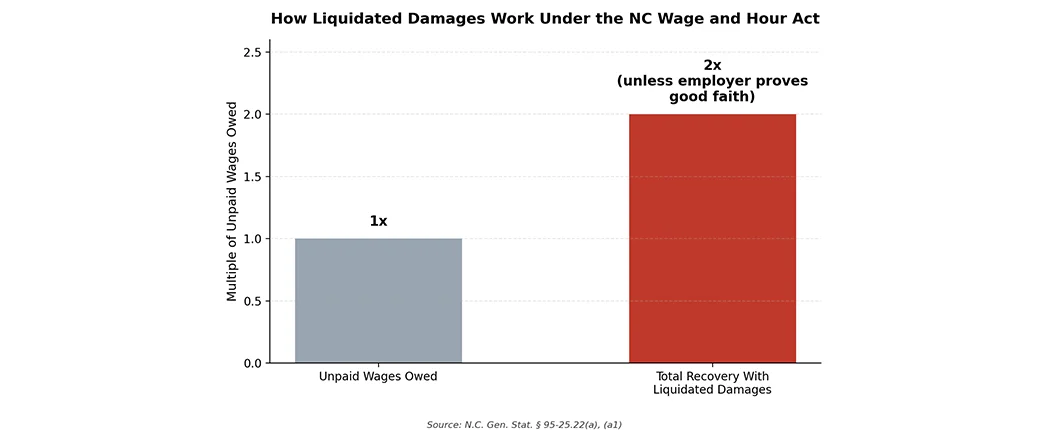
Figure 2. How North Carolina’s Wage and Hour Act doubles unpaid wage recoveries through liquidated damages.
When an employer violates these rules, North Carolina General Statutes Section 95-25.22 provides a meaningful remedy: the employee is entitled to the unpaid wages plus interest, and the court must also award liquidated damages equal to that same amount, effectively doubling the recovery, unless the employer proves the violation resulted from a good-faith mistake with reasonable grounds. A prevailing employee is also entitled to recover attorney’s fees and costs under the same statute.
Source: N.C. Gen. Stat. §§ 95-25.7, 95-25.13, 95-25.22.
Non-Compete Agreements: North Carolina’s Strict Blue Pencil Rule
North Carolina generally enforces non-compete agreements when they are reasonable in duration, geographic area, and the scope of restricted activity, but the state applies one of the strictest rules in the country when an agreement goes too far. Under North Carolina’s blue pencil doctrine, confirmed by the North Carolina Supreme Court in Beverage Systems of the Carolinas, LLC v. Associated Beverage Repair, LLC in 2016, a court may strike a distinctly separable overbroad provision from a non-compete, but it has no authority to rewrite or narrow an unreasonable provision to make it enforceable, even when the parties’ own contract explicitly asks the court to do so.
In Beverage Systems, a non-compete restricted competition across all of North Carolina and South Carolina, even though the business at issue only operated in limited portions of each state. Because the agreement contained only a single, indivisible territorial restriction, the court could not simply narrow it to the actual area of operation.
Striking the entire provision left the agreement with no geographic limitation, making the whole non-compete unenforceable despite contract language specifically authorizing the court to rewrite it. North Carolina also requires new, separate consideration, something of value beyond continued employment alone, when a non-compete is introduced or modified after employment has already begun.
This consideration requirement catches many employers off guard, since a non-compete presented to an existing employee as a routine update to company policy, with nothing new offered in exchange, is often unenforceable for this reason alone, regardless of how reasonable its actual terms might otherwise be.
Source: Beverage Systems of the Carolinas, LLC v. Associated Beverage Repair, LLC, 368 N.C. 693 (2016).
North Carolina Is A Right-To-Work State
North Carolina General Statutes Section 95-78 and related provisions establish North Carolina as a right-to-work state, meaning no employee can be required to join or financially support a labor union as a condition of employment. This affects the landscape of unionized workplaces in Charlotte, but it does not affect an employee’s separate rights under federal labor law, discrimination statutes, or North Carolina’s wage-and-hour and retaliation protections. Whether or not a workplace is unionized, an employee’s rights under REDA, the Wage and Hour Act, and federal discrimination law remain fully intact and operate independently of right-to-work status.
Source: N.C. Gen. Stat. § 95-78 et seq.
Severance Agreements And Age Discrimination Waivers
Employees offered a severance package in exchange for signing a release of legal claims should understand that not every waiver is enforceable in every circumstance. Under the federal Older Workers Benefit Protection Act, a release of age discrimination claims under the Age Discrimination in Employment Act is only valid if it meets specific requirements, including giving the employee at least 21 days to consider the agreement, or at least 45 days in the case of a group layoff, along with a 7-day period after signing during which the employee may revoke acceptance.
A severance agreement that fails to meet these requirements may not waive an age discrimination claim, regardless of what the document says. Employees are also generally entitled to receive, in writing, information about the job titles and ages of employees selected and not selected for a group layoff, which is meant to allow a meaningful opportunity to evaluate whether age played a role in the decision before agreeing to sign away any claim.
Source: Older Workers Benefit Protection Act, 29 U.S.C. § 626(f).
Unemployment Insurance Benefits After A Job Loss
Workers who lose a job in Charlotte may be eligible for unemployment benefits through the North Carolina Division of Employment Security. Eligibility generally depends on the reason for separation, and an employer can contest a termination as misconduct. An employee denied benefits, or an employer disputing a former employee’s claim, can appeal an initial determination through the Division’s administrative hearing process, and the outcome can also become relevant evidence in a related wrongful termination or discrimination case.
Testimony given during an unemployment hearing, and any factual findings that come out of it, are sometimes referenced later in a separate wrongful termination or discrimination lawsuit, which makes how that hearing is handled worth taking seriously even when the amount of unemployment benefits at stake seems modest compared to a potential civil claim.
Common Employment Matters We Handle In Charlotte
- Wrongful termination in violation of North Carolina public policy
- Race, sex, age, disability, national origin, and religious discrimination
- Sexual harassment and hostile work environment claims
- Retaliation for workers’ compensation claims, safety complaints, or wage complaints under REDA
- Unpaid wages, unpaid overtime, and misclassification of employees as independent contractors
- Non-compete and non-solicitation agreement disputes
- Severance agreement review and negotiation
- Unemployment insurance benefit disputes and appeals
- Family and Medical Leave Act violations
- Pregnancy and disability accommodation disputes
Common Myths About Employment Law Versus North Carolina Reality
| Common Myth | The Legal Reality In North Carolina |
| My employer can fire me for any reason since North Carolina is at-will | At-will employment has real limits, including North Carolina’s public policy exception recognized in Coman v. Thomas Manufacturing Co. and specific statutes like REDA |
| I can sue my employer directly under North Carolina’s discrimination law | North Carolina’s Equal Employment Practices Act does not create its own private lawsuit; discrimination claims generally proceed through the EEOC and federal law, or through a common law wrongful discharge claim built on that statute’s public policy |
| My non-compete is enforceable exactly as written because I signed it | North Carolina courts can strike, but not rewrite, an overbroad non-compete, and an indivisible overbroad restriction can invalidate the entire agreement |
| I only get back the wages I was actually owed if I win a wage claim | North Carolina law generally doubles a successful wage claim through mandatory liquidated damages, plus attorney’s fees, unless the employer proves a good faith mistake |
Frequently Asked Questions
Common Concerns Before Calling An Employment Lawyer
I Do Not Have A Written Contract, So I Assume I Have No Protection
Most employment protections in North Carolina, including discrimination, retaliation, and wage laws, apply regardless of whether you have a written employment contract. At-will status affects whether you can be fired without cause, not whether that firing can still be unlawful. Many employees mistakenly assume at-will status answers every question about a termination, when in reality it only addresses whether cause was required in the first place.
My Employer Said I Signed Away My Rights In My Offer Letter
Not every provision in an offer letter or employee handbook is enforceable, and some waivers, particularly of certain federal discrimination claims, must meet specific legal requirements to be valid at all. Review this rather than assume it, since a document’s confident language does not, by itself, determine whether it holds up under North Carolina and federal law.


It Has Been Several Months Since I Was Retaliated Against
Time matters considerably in employment cases. A REDA retaliation complaint must generally be filed within 180 days, and an EEOC discrimination charge generally has the same 180-day window, both considerably shorter than the three-year deadline that applies to some other employment claims. Waiting to see how a situation develops before contacting an attorney can mean losing access to the shortest and often most straightforward path to relief, even when a longer common law deadline technically remains available.
What Happens When You Call The Watson Law Office
When you call (704) 885-5025, a member of The Watson Law Office team will ask about your job, what happened, and any documentation you already have, such as an offer letter, employee handbook, or termination notice. If your case is a good fit, you will be scheduled for a consultation with Attorney Kyle T. Watson, who can help you understand which North Carolina and federal protections apply to your specific situation and what deadlines may already be running. Bring copies of any relevant emails, performance reviews, or written complaints you made internally, since this documentation often becomes central to evaluating the strength of a potential claim.
If you are dealing with discrimination, retaliation, unpaid wages, or wrongful termination in Charlotte, do not assume North Carolina’s at-will rule means you have no options before you understand your rights. Call (704) 885-5025 today for a no-obligation case review.
