

A Charlotte truck accident lawyer helps people hurt by tractor-trailers, delivery trucks, and other commercial vehicles pursue compensation from the driver, the trucking company, and other responsible parties. Truck crashes involve federal safety regulations, much higher insurance limits, and evidence, such as black box and electronic logging data, that can disappear within days. The Watson Law Office offers a free case review at (704) 885-5025.
A collision with a fully loaded tractor-trailer rarely compares to an ordinary car accident in terms of both the injuries involved and the legal process that follows. Commercial trucking is governed by a layer of federal safety law that does not apply to passenger vehicles, and the companies behind these trucks typically have insurers and legal teams investigating the crash within hours. North Carolina’s general negligence rules, including its pure contributory negligence standard and three-year filing deadline (covered in full on our personal injury overview page), still apply, but a truck accident claim adds federal regulations, corporate defendants, and time-sensitive evidence to the mix.

Why Charlotte Sees So Much Commercial Truck Traffic
Charlotte sits at the intersection of Interstate 85 and Interstate 77, two of the busiest freight corridors in the southeastern United States, with Interstate 485 forming an outer loop that channels regional truck traffic around the city. This position, combined with Charlotte’s role as a major banking, manufacturing, and distribution center, has made the region one of the Southeast’s primary logistics hubs, served by extensive rail infrastructure from Norfolk Southern and CSX alongside its interstate highway network.
Air cargo adds another layer of truck traffic to Charlotte’s roads. Charlotte Douglas International Airport handled 205,700 tons of cargo in 2024, a 7.3 percent increase over the prior year, and cargo volume grew another 14.1 percent in the first seven months of 2025. Nearly all of that freight moves to and from the airport by truck, adding to the volume of commercial vehicles on Charlotte’s interstates and surface streets every day.
Source: Charlotte Douglas International Airport (CLT), CLTea cargo reporting, 2025.
Federal Regulations That Apply Only To Commercial Trucks
Passenger vehicle drivers in Charlotte answer to North Carolina traffic law. Commercial truck drivers and the companies that employ them must also comply with an extensive body of federal regulation administered by the Federal Motor Carrier Safety Administration, or FMCSA. These rules create duties that do not exist in an ordinary car accident case, and a trucking company’s violation of them is often central evidence of negligence.
Hours Of Service Limits
FMCSA hours-of-service rules exist specifically to prevent fatigue-related crashes, one of the most consistently cited causes of serious truck accidents nationwide.
| Rule | Limit |
| Maximum driving time | 11 hours, within a 14-hour on-duty window |
| Required off-duty period | 10 consecutive hours before starting a new shift |
| Weekly driving cap | 60 hours in 7 consecutive days, or 70 hours in 8 consecutive days |
| Electronic Logging Device requirement | Mandatory since December 18, 2017, for most interstate drivers |
Source: 49 C.F.R. Part 395, Federal Motor Carrier Safety Administration.
Minimum Insurance Requirements
Federal law requires far higher insurance limits for commercial trucks than North Carolina requires for passenger vehicles, reflecting the far greater harm a loaded commercial vehicle can cause in a crash.
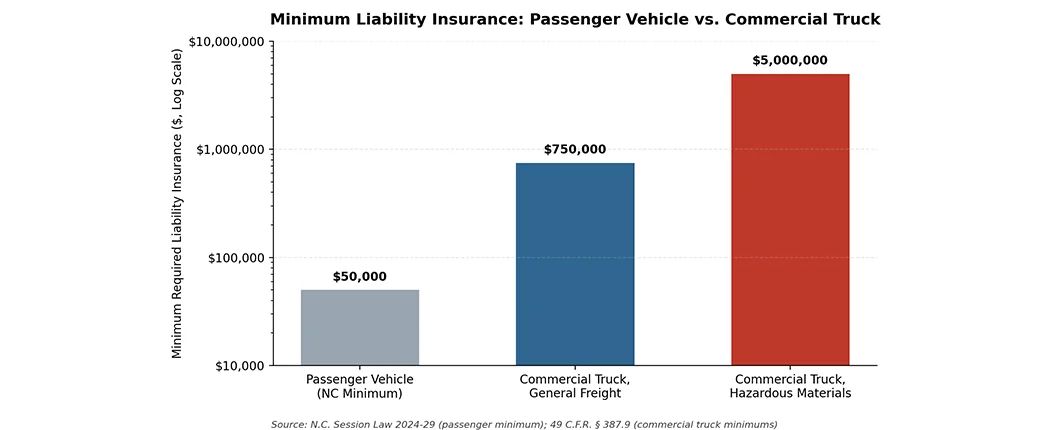
Figure 1. Minimum liability insurance, passenger vehicle versus commercial truck.
A commercial truck over 10,001 pounds hauling general freight must carry at least 750,000 dollars in liability coverage, fifteen times North Carolina’s current passenger vehicle minimum. Trucks hauling hazardous materials must carry as much as 5 million dollars in coverage. This is one of the most important practical differences between a car accident claim and a truck accident claim in Charlotte, since it means significantly more compensation may actually be available, provided liability and damages are properly established.
Source: 49 C.F.R. § 387.9, Federal Motor Carrier Safety Administration.
Who Can Be Held Liable After A Charlotte Truck Accident
Unlike a typical two-car collision, a Charlotte truck accident claim frequently involves more than one potentially liable party. Identifying every responsible party matters because it can open access to additional insurance coverage beyond the driver’s own policy.
| Potentially Liable Party | Basis For Liability |
| The Truck Driver | Direct negligence, such as speeding, fatigue, distraction, or hours of service violations. |
| The Trucking Company | Vicarious liability for its driver’s conduct, plus direct claims for negligent hiring, training, supervision, or retention of an unsafe driver. |
| The Cargo Loading Company | Improperly loaded or secured cargo that shifts, spills, or causes a rollover. |
| The Truck Or Parts Manufacturer | Product liability claims when a defective component, such as brakes, tires, or steering systems, contributes to the crash. |
| The Maintenance Contractor | Negligent inspection or repair work that leaves a truck unsafe to operate. |
Because trucking companies carry substantial insurance and face direct liability for how they hire and supervise drivers, they routinely maintain internal safety files, driver qualification records, and inspection logs that become critical evidence once a claim is filed.
Why It Rarely Matters If The Driver Was An Independent Contractor
Trucking companies have historically tried to avoid liability by classifying drivers as independent contractors rather than employees. Federal law closes that loophole. Under 49 C.F.R. Section 376.12(c)(1), a motor carrier that leases a truck must assume complete responsibility for the operation of that equipment for the duration of the lease, and courts have long held that this creates a statutory employment relationship between the carrier and the driver for liability purposes, regardless of how their contract is worded. Separately, 49 C.F.R. Section 390.5 defines an employee under the federal safety regulations to include an independent contractor while operating a commercial motor vehicle. In practice, this means that if a truck displays a carrier’s operating authority, the carrier is generally answerable for that driver’s negligence as a matter of law, even when the driver is technically self-employed or leased through another company.
Source: 49 C.F.R. § 376.12(c)(1); 49 C.F.R. § 390.5.
Federal Driver Qualification And Drug Testing Rules
FMCSA regulations also govern who a trucking company can put behind the wheel in the first place. Under 49 C.F.R. Part 391, motor carriers must maintain a driver qualification file for each driver, including employment history, a road test, and verification of a valid commercial driver’s license. Under 49 C.F.R. Part 382, drivers are subject to mandatory pre-employment, random, post-accident, and reasonable suspicion drug and alcohol testing. When a trucking company fails to follow these requirements, whether by skipping a background check, ignoring a prior safety violation, or failing to test a driver after a crash, that failure can support a direct negligent hiring or negligent retention claim against the company itself, separate from whatever the driver did wrong on the road.
Source: 49 C.F.R. Part 391; 49 C.F.R. Part 382.
The Evidence That Disappears Fastest In Truck Accident Cases
Modern commercial trucks generate an unusual amount of electronic data, and most of it is retained only for a limited time unless a party is formally notified to preserve it. This makes the first days after a Charlotte truck accident especially consequential for evidence gathering.
- Electronic Control Module, or black box, data recording speed, braking, and throttle position in the moments before impact
- Electronic Logging Device records showing the driver’s hours of service leading up to the crash
- Dash cam or inward-facing cab camera footage, increasingly common on commercial fleets
- Driver qualification files, training records, and prior violation history maintained by the trucking company
- Maintenance and inspection logs for the specific vehicle involved
Because trucking companies and their insurers routinely begin investigating a crash within hours, sending a formal spoliation letter, a written demand to preserve this evidence, is one of the first steps an experienced Charlotte truck accident attorney takes. Without that notice, some of this data may be legally and routinely overwritten before a claim is ever filed.
Common Causes Of Charlotte Truck Accidents
- Driver fatigue from hours of service violations or unrealistic delivery schedules
- Improperly loaded, overloaded, or unsecured cargo
- Equipment failure, including brake and tire defects, tied to inadequate maintenance
- Blind spot, or no-zone, collisions during lane changes on congested corridors such as Interstate 85 and Interstate 77
- Wide turns onto Charlotte’s narrower surface streets, particularly in older parts of the city not designed for large commercial vehicles
- Distracted or impaired driving, the same underlying causes documented across North Carolina’s broader crash data
Cargo-related causes deserve particular attention in a logistics hub like Charlotte, where trucks frequently make short hauls between distribution centers, the airport, and retail destinations, sometimes with less rigorous loading oversight than a long-haul carrier applies. A shifted or improperly secured load can cause a rollover on a highway ramp or ejected cargo on a surface street, and liability in these cases often extends to the company that loaded the truck, not just the driver or the carrier.


Why Truck Accident Injuries Tend To Be More Severe
A fully loaded tractor-trailer can weigh up to 80,000 pounds under federal weight limits, compared to an average passenger car weighing roughly 4,000 pounds. That weight differential, combined with a commercial truck’s higher ground clearance, means the same crash dynamics that produce a moderate injury in a car-to-car collision frequently produce catastrophic injury, including traumatic brain injury, spinal cord damage, or death, when a passenger vehicle is involved. This severity gap is a major reason federal law requires higher insurance minimums for commercial trucks, and why fully valuing a truck accident claim typically requires input from medical specialists and, in serious cases, life care planners who can project long-term treatment needs.
Types Of Commercial Trucks On Charlotte Roads
Not every commercial vehicle on Charlotte’s roads is a long-haul tractor-trailer, and the type of vehicle involved often affects which regulations, insurance policies, and companies are relevant to a claim.
- Tractor-trailers and semi-trucks handling long-haul freight along Interstate 85 and Interstate 77
- Box trucks and delivery vans operated by regional carriers and last-mile delivery services, reflecting Charlotte’s growth as a distribution hub
- Dump trucks and construction vehicles tied to the region’s ongoing highway and development projects
- Tanker trucks hauling fuel or other liquid cargo, which carry the highest federal insurance minimums due to hazardous materials risk
- Waste and recycling trucks, garbage trucks, and other municipal or contracted service vehicles
Delivery vans and last-mile carriers deserve particular attention in a growing logistics market like Charlotte. Depending on the vehicle’s size and weight and the nature of the carrier’s operations, some smaller delivery vehicles fall outside certain FMCSA weight-based thresholds, which can change which regulations and insurance requirements apply. Correctly identifying the vehicle type and its regulatory classification is an early step in evaluating any Charlotte truck accident claim.
How Long A Charlotte Truck Accident Claim Typically Takes
Truck accident claims generally take longer to resolve than an ordinary car accident claim, and understanding why helps set realistic expectations. Serious truck crashes often trigger a federal or state investigation separate from any civil claim, and obtaining complete driver logs, maintenance records, and company safety files can take much longer than gathering the equivalent documents in a two-vehicle collision.
When multiple potentially liable parties are involved, such as a carrier, a cargo loader, and a maintenance contractor, each with its own insurer and legal counsel, coordinating a resolution simply takes more time than a single-defendant claim. Cases involving catastrophic injury add another layer of delay, since a full and fair settlement typically cannot be evaluated until your treating physicians can reasonably project your long-term medical needs. This is not a reason to delay contacting an attorney. It is a reason to have one from the earliest possible point, since the evidence-preservation window described above closes long before the claim itself resolves.
How A Truck Accident Claim Differs From An Ordinary Car Accident Claim
Every general principle that applies to a Charlotte car accident claim, covered in detail on our car accident page, including North Carolina’s pure contributory negligence rule and the three-year statute of limitations, still applies to a truck accident. What changes is the case’s scale and complexity. A trucking company typically assigns a rapid response team, sometimes including its own accident reconstructionist, to the scene within hours. Its insurer will often reach out quickly, sometimes with an early settlement offer designed to resolve the claim before the full extent of injuries or the full set of liable parties is known. Because these cases usually involve more coverage and more potentially responsible parties, they reward early, thorough investigation far more than a routine two-car collision does.
Frequently Asked Questions
Common Concerns Before Calling A Truck Accident Lawyer
The Trucking Company Already Offered To Cover My Medical Bills
An early offer, even a seemingly generous one, is typically calculated before the full extent of your injuries is known and before liability has been fully investigated. Accepting it can foreclose a much larger claim once you properly account for ongoing treatment, lost income, and the true scope of the trucking company’s coverage.
I Am Not Sure If The Driver Or The Company Is Responsible
That determination is often the central question in a truck accident case, and it does not need to be resolved before you speak with an attorney. Driver logs, company safety records, and maintenance files typically clarify this picture once they are obtained.


This Case Seems More Complicated Than I Can Handle Right Now
Truck accident cases are more document-intensive than an ordinary car accident claim, which is exactly why early legal representation matters. A consultation costs nothing and can clarify what evidence you need to preserve immediately.
I Was Told The Crash Is Still Under Federal Investigation
A separate federal or state safety investigation does not prevent you from pursuing a civil claim, and the two processes generally proceed on different tracks. In some cases, findings from a federal investigation can become useful evidence in your claim once they are available, but waiting for that investigation to conclude before starting your own case can mean losing time on evidence that will not wait, such as electronic logs and black box data.
What Happens When You Call The Watson Law Office
When you call (704) 885-5025, a member of The Watson Law Office team will ask about the crash, the vehicles and companies involved, and any contact you have already had with an insurance adjuster. This conversation is free and carries no obligation. If your case is a good fit, you will be scheduled for a consultation with Attorney Kyle T. Watson, who can advise on immediate evidence-preservation steps, given how quickly trucking companies and their insurers move after a serious crash.
