

A Charlotte bicycle accident lawyer helps injured cyclists pursue compensation after a driver fails to pass safely, yield the right of way, or check for a rider before opening a car door. North Carolina law treats bicycles as vehicles with the same rights and duties as cars, and it sets specific passing distances and equipment requirements that most drivers, and even some cyclists, do not fully know. The Watson Law Office offers a free case review at (704) 885-5025.
Charlotte’s growing greenway and bike lane network has made cycling a bigger part of daily life in neighborhoods across the city, but that growth has not eliminated the basic imbalance at the heart of every bicycle crash: a rider has no metal frame, airbags, or seatbelt between themselves and the pavement. The general rules covered on our personal injury overview page, including North Carolina’s pure contributory negligence standard and three-year filing deadline, apply fully to bicycle claims, but riders face a distinct body of law governing passing distance, lighting, and right of way that shapes how fault gets decided.

Bicycles Are Legally Vehicles In North Carolina
Under North Carolina General Statutes Section 20-4.01(49), the legal definition of a vehicle specifically includes bicycles, and every bicyclist on a highway is subject to the same provisions that apply to the driver of a motor vehicle, except for rules that by their nature cannot apply to a bicycle. Sections 20-171.1 and 20-171.3, part of the Operation of Bicycles article of North Carolina’s motor vehicle laws, reinforce this status directly, granting a bicyclist all of the rights and subjecting them to all of the duties applicable to a vehicle driver.
This status often favors a rider more than many people assume. The same left-turn yielding duty described on our car accident page, requiring a driver turning left to yield to oncoming traffic under North Carolina General Statutes Section 20-155(b), applies with equal force when a driver turns in front of an oncoming cyclist. A driver who claims a cyclist “came out of nowhere” at an intersection is making exactly the kind of argument North Carolina courts have rejected for decades in ordinary vehicle-on-vehicle collisions. The same is true of right-of-way disputes at four-way stops and unmarked intersections, where a bicycle waiting its turn is entitled to the same treatment as a car in the same position.
Source: N.C. Gen. Stat. §§ 20-4.01(49), 20-171.1, 20-171.3.
How Much Space A Driver Must Give You When Passing
North Carolina law sets a specific minimum distance for passing a bicyclist, and the requirement is more generous than most drivers realize. Under North Carolina General Statutes Section 20-149(a), a driver overtaking a bicycle must leave at least two feet of clearance. A 2016 amendment, codified at Section 20-150(e), went further, allowing a driver to cross into a marked no-passing zone to pass a cyclist, but only if the driver provides at least four feet of clearance or moves completely into the adjacent lane, and only when the cyclist is not making or signaling a left turn.
Figure 1. North Carolina’s minimum passing distance for bicycles, by roadway type.
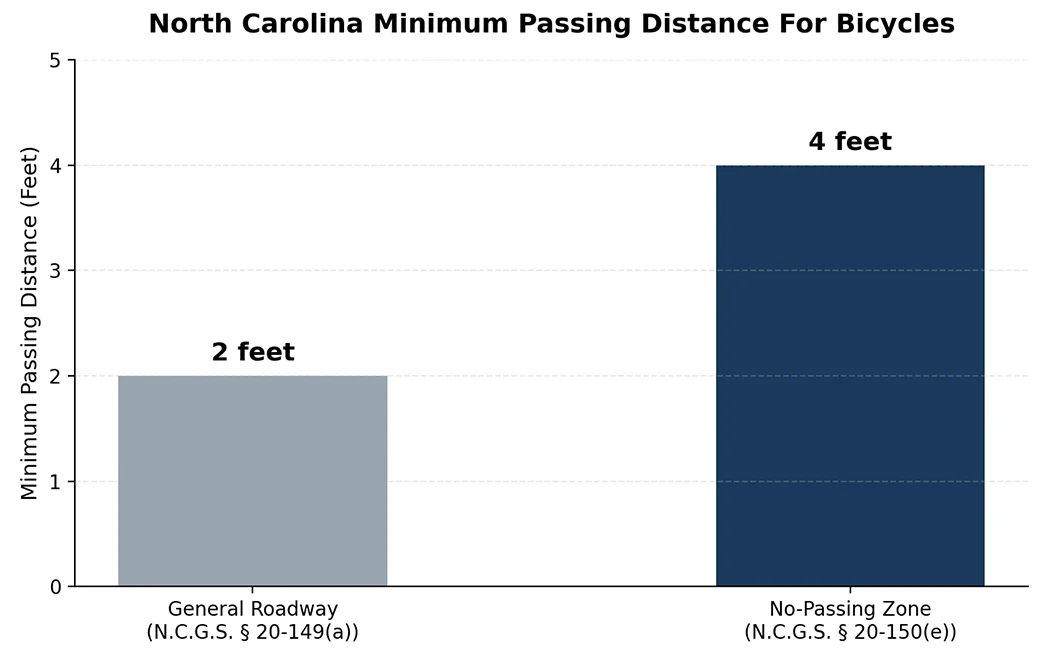
A driver who passes closer than the law allows, whether on an open roadway or in a marked no-passing zone, has violated a specific, objective legal standard. This is one of the more useful facts in a Charlotte bicycle crash claim, since it converts what might otherwise be a vague dispute over how much space was reasonable into a measurable legal violation. Skid marks, vehicle mirror damage, and even the bicycle’s final resting position relative to the roadway edge can help establish how much clearance a driver actually provided at the moment of impact.
Source: N.C. Gen. Stat. §§ 20-149(a), 20-150(e).
The Dooring Problem And Why North Carolina Law Falls Short
Dooring, when a driver or passenger opens a car door directly into a cyclist’s path, is one of the most common serious collision types in dense urban cycling environments, and Charlotte’s street-parking-heavy corridors are no exception. North Carolina is one of fewer than ten states without a statewide dooring statute that specifically penalizes opening a vehicle door unsafely. Some North Carolina municipalities, including Raleigh and Chapel Hill, have adopted local dooring ordinances with misdemeanor penalties, but as of this writing, there is no indication Charlotte has adopted an equivalent ordinance.
The absence of a specific statute does not mean a doored cyclist has no claim. General negligence principles still apply: a driver or passenger who opens a door without checking for approaching traffic, including bicycles, can be found negligent under ordinary duty-of-care standards, even without a dedicated dooring statute. Proving that claim without the benefit of a clear statutory violation, however, often requires more detailed investigation, including witness statements and, where available, nearby camera footage, than a claim resting on an objective passing-distance violation.
Building a dooring claim on ordinary negligence rather than a specific statute means the timeline of events matters more than it would in a passing-distance case. How long the door had been open, whether the vehicle’s hazard lights were on, whether the occupant looked in a mirror or over a shoulder before opening the door, and how far into the travel lane or bike lane the door extended are all facts that typically need to be gathered quickly, before witnesses’ memories fade and before any nearby surveillance footage is overwritten or deleted. Businesses along commercial corridors frequently retain security camera footage for only a short window, often measured in days rather than weeks, which makes prompt evidence requests especially important in a Charlotte dooring case.
Required Equipment And What It Means For Fault
Lighting Requirements
Under North Carolina General Statutes Section 20-129, every bicycle operated at night on a public street, public vehicular area, or public greenway must have a lighted front lamp visible from at least 300 feet and a rear reflector or lamp visible from at least 200 feet. Riding without required lighting can support an argument that the cyclist bears some fault for a nighttime crash, which matters considerably under North Carolina’s pure contributory negligence rule. Conversely, a properly lit cyclist undercuts any driver claim that the rider was simply impossible to see.
Source: N.C. Gen. Stat. § 20-129(e).
Helmet Law Applies Only To Riders Under 16
Unlike North Carolina’s motorcycle helmet law, which applies to riders of every age, the state’s Child Bicycle Safety Act, codified at North Carolina General Statutes Section 20-171.9, requires a helmet only for bicycle operators and passengers under 16. For an adult cyclist, North Carolina imposes no helmet requirement, so an insurance company cannot point to an adult rider’s lack of a helmet as a violation of any law, because no such law exists for adults.


Even for a minor, the statute places the legal obligation on the parent or guardian, not the child. North Carolina General Statutes Section 20-171.9(a) makes it unlawful for a parent or legal guardian to knowingly permit a person under 16 to ride without a helmet, and violations carry a modest civil fine that can be waived with proof of a helmet purchase. This structure means a child’s own claim following a crash is not undermined by a missing helmet in the same direct way a contributory negligence argument might otherwise suggest, since the statute frames the violation as the parent’s, not the child’s. This distinction can matter considerably in a case involving a young rider, since it separates who is at fault for the crash itself from the separate, legally distinct question of who bears responsibility for a helmet violation.
Source: N.C. Gen. Stat. § 20-171.9.
How North Carolina’s Bicycle Laws Compare At A Glance
| Legal Question | North Carolina Rule |
| Is a bicycle a vehicle under the law? | Yes, under N.C. Gen. Stat. § 20-4.01(49); the same rights and duties as a motor vehicle apply |
| Minimum passing distance, general roadway | 2 feet, under N.C. Gen. Stat. § 20-149(a) |
| Minimum passing distance, no-passing zone | 4 feet, or a full lane change, under N.C. Gen. Stat. § 20-150(e) |
| Nighttime lighting requirement | Front lamp visible 300 feet, rear reflector or lamp visible 200 feet, under N.C. Gen. Stat. § 20-129(e) |
| Helmet requirement | Required only for riders under 16, under N.C. Gen. Stat. § 20-171.9; no requirement for adults |
| Dooring | No statewide statute; a small number of NC cities have local ordinances, but general negligence principles apply statewide |
| Left-turn right of way | Same duty to yield described under N.C. Gen. Stat. § 20-155(b) that applies to any oncoming vehicle |
Common Types Of Charlotte Bicycle Accidents
- Right-hook collisions, where a driver turning right crosses directly in front of a cyclist traveling straight through an intersection or bike lane
- Left-turn collisions, where an oncoming driver turns across a cyclist’s path, governed by the same yielding duty that applies to any oncoming vehicle
- Dooring incidents on street-parking corridors, particularly in dense areas like NoDa, Plaza Midwood, and South End
- Rear-end collisions, often on roads without a marked bike lane, where a following driver misjudges a cyclist’s speed
- Overtaking violations, where a driver passes with less than the legally required clearance
- Sideswipe collisions during a driver’s lane change or merge without checking for a cyclist riding along the road’s edge
- Road hazard and infrastructure crashes, including poorly maintained greenway crossings, storm drain grates, and construction zones that force cyclists into vehicle traffic
Charlotte’s expanding greenway network, including the Little Sugar Creek Greenway and the developing Cross Charlotte Trail, has shifted some cycling traffic off city streets, but it has also introduced its own hazards where greenways cross active roadways. These crossings frequently lack the same signal timing and visibility protections as a standard intersection, and a driver’s failure to yield at a marked greenway crossing raises many of the same legal questions as a failure to yield at a conventional intersection.
North Carolina’s 2024 Bicycle Crash Data
The state’s official 2024 Crash Facts report recorded 40 pedal-cyclists killed in North Carolina traffic crashes, the same number as 2023, with 35.0 percent of those killed between the ages of 40 and 59. While North Carolina does not break these figures down to the county or city level in its summary reporting, Mecklenburg County’s high overall crash and traffic volume, documented in detail on our personal injury overview page, makes it one of the counties where cyclist-involved crashes are reported most frequently.
Source: NCDOT 2024 Crash Facts, North Carolina Department of Transportation.
Electric Bicycles Are Becoming More Common On Charlotte Roads
Electric bicycles have grown quickly as a commuting and delivery option across Charlotte, and North Carolina law treats most of them similarly to traditional bicycles. Under North Carolina General Statutes Section 20-4.01, an electric assisted bicycle is defined as a bicycle with a motor of no more than 750 watts, a maximum motor-powered speed of 20 miles per hour, and fully operable pedals.
Riders must be at least 16 years old, and they do not need a license, registration, or insurance to operate one. Because an electric-assisted bicycle meets North Carolina’s definition of a bicycle for most purposes, the same passing-distance, lighting, and right-of-way rules described above generally apply to a rider struck while on one, though the added speed of an electric motor can affect how fault and comparative timing are analyzed in a specific crash.
Source: N.C. Gen. Stat. § 20-4.01.
Common Injuries In Charlotte Bicycle Accidents
A cyclist has even less physical protection than a motorcyclist in a collision with a car or truck, and the resulting injuries reflect that gap.
- Road rash and severe abrasions from sliding across pavement after being struck or thrown from the bicycle
- Fractures to the wrist, forearm, and collarbone, common when a rider extends an arm to break a fall
- Traumatic brain injury, a particular concern given that North Carolina imposes no helmet requirement on adult riders
- Facial and dental injuries from direct impact with a vehicle, the pavement, or the bicycle itself
- Soft tissue and orthopedic injuries to the hips and knees from impact or from the bicycle frame during a collision
Common Insurer Assumptions About Cyclists Versus North Carolina Law
| Common Insurer Assumption | The Legal Reality In North Carolina |
| The cyclist should have been on the sidewalk | North Carolina law does not require cyclists to ride on a sidewalk, and bicycles have the same right to use the roadway as any other vehicle |
| The cyclist was not wearing a helmet, so they share fault | No helmet law applies to adult cyclists at all in North Carolina, and even for a minor, the statutory violation belongs to the parent, not the child |
| The driver could not have safely passed at a distance | North Carolina law sets an objective 2-foot or 4-foot minimum distance depending on the roadway, regardless of a driver’s subjective sense of what felt safe |
| Dooring is just an unavoidable accident | A driver or passenger who fails to check for approaching cyclists before opening a door can still be found negligent under general duty-of-care principles |
Frequently Asked Questions
What Happens When You Call The Watson Law Office


When you call (704) 885-5025, a member of the Watson Law Office team will ask about your accident, your injuries, and any contact you have already had with an insurance company. This conversation is free and carries no obligation. If your case is a good fit, you will be scheduled for a consultation with Attorney Kyle T. Watson, who can help you understand how North Carolina’s passing, lighting, and right-of-way laws apply to your specific crash. Bring your CMPD crash report if you have one, along with any photographs of the scene, your bicycle, and your injuries, so the consultation can move directly into evaluating your options.
