


Charlotte personal injury lawyers help accident victims pursue compensation for medical bills, lost wages, and pain and suffering after a car crash, fall, or other negligent act in Mecklenburg County. North Carolina follows a strict contributory negligence rule and a three-year filing deadline, so early legal guidance matters. The Watson Law Office, led by former defense attorney Kyle T. Watson, offers a free case review at (704) 885-5025.
A Charlotte personal injury lawyer represents people hurt by someone else’s negligence and works to recover compensation for medical care, lost income, and pain and suffering. Mecklenburg County recorded 38,400 traffic crashes in 2025 alone, and North Carolina applies one of the country’s harshest fault rules to injury claims. Getting the right legal guidance early, before you talk to an insurance adjuster, often determines whether you recover anything at all.

What Counts As A Personal Injury Claim In Charlotte
Personal injury law covers any situation where another person’s carelessness, recklessness, or intentional conduct causes harm. In Charlotte and the rest of Mecklenburg County, the most common claims The Watson Law Office sees involve motor vehicle collisions, but the same legal principles apply to a wide range of situations.
- Car, truck, motorcycle, and rideshare collisions on roads such as Independence Boulevard, I-77, and South Tryon Street
- Pedestrian and bicycle accidents in dense corridors like Uptown, South End, and NoDa
- Slip and fall or other premises liability incidents at stores, apartment complexes, or public property
- Dog bites and animal attacks
- Medical malpractice during treatment at a Charlotte-area hospital or clinic
- Defective or dangerous products that cause injury
- Wrongful death caused by any of the above
Charlotte’s growth has reshaped these claims over the past decade. Dense corridors like South End and NoDa mix pedestrians, cyclists, and drivers in tighter spaces than the city’s road network was built for, while a booming rideshare market has added an entirely new layer of insurance questions that many injured Charlotte residents don’t learn about until after they are hurt.
How Often Crashes Happen In Charlotte, And Where
The Charlotte-Mecklenburg Police Department Traffic Safety Unit and the North Carolina Department of Transportation Crash Data Portal reported 38,400 total crashes across Charlotte in 2025, including 4,950 injury crashes and 176 traffic fatalities. That total reflects a 9 percent increase over 2024 and a 7 percent rise in serious injuries, continuing a three-year upward trend in reported crash volume. On an average day, that works out to roughly 105 crashes across the city.
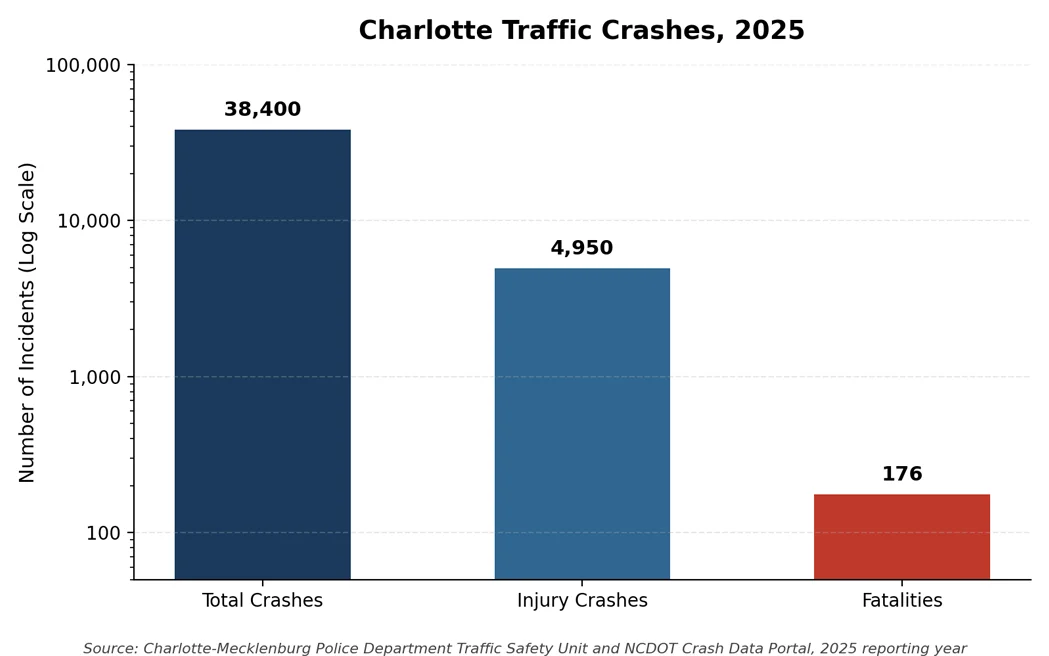
Figure 1. Charlotte traffic crash totals, 2025 reporting year.
The same data identifies Independence Boulevard, Interstate 77, and South Tryon Street as the corridors with the highest collision rates in the city. At the intersection level, Sugar Creek Road at North Tryon Street logged more than 66 reported crashes in the reviewed period, the highest single-intersection frequency in Mecklenburg County. Distracted driving remains the leading reported cause of Charlotte crashes, followed by speeding and impaired driving, and pedestrian and motorcycle fatalities rose roughly 12 percent year over year.
Source: Charlotte-Mecklenburg Police Department Traffic Safety Unit and NCDOT Crash Data Portal, 2025 reporting year.
North Carolina’s Contributory Negligence Rule
North Carolina is one of only four states, along with Alabama, Maryland, and Virginia, plus the District of Columbia, that still follows pure contributory negligence. Under this rule, if you are found even 1 percent at fault for your own accident, you can be barred from recovering any compensation at all, even if the other driver was 99 percent responsible. Most other states use some form of comparative negligence, where your recovery is simply reduced by your share of fault rather than eliminated entirely.
North Carolina law places the burden of proving contributory negligence on the defendant, not on you. Under North Carolina General Statutes Section 1-139, the insurance company or the party being sued must plead and prove that you shared fault. That’s why insurance adjusters in Charlotte move quickly to get recorded statements after a crash. A single sentence taken out of context, such as admitting you glanced at your phone or were driving a few miles over the limit, can be used to argue you contributed to your own injury and to deny the claim entirely.
An important exception exists called the last clear chance doctrine. If the other party had a final, clear opportunity to avoid the accident but failed to take it, your own partial fault may not bar your recovery. Applying this doctrine correctly requires a detailed, fact-specific investigation, which is one of the most valuable services an experienced Charlotte personal injury attorney provides.
Source: N.C. Gen. Stat. § 1-139; North Carolina appellate case law applying the pure contributory negligence standard.
North Carolina Raised Its Minimum Insurance Requirements In 2025
For the first time in nearly 25 years, North Carolina increased the minimum auto liability insurance every driver must carry. Under Session Law 2024-29, also known as Senate Bill 319, policies issued or renewed on or after July 1, 2025 must meet new minimum limits of 50/100/50, up from the old 30/60/25 standard.
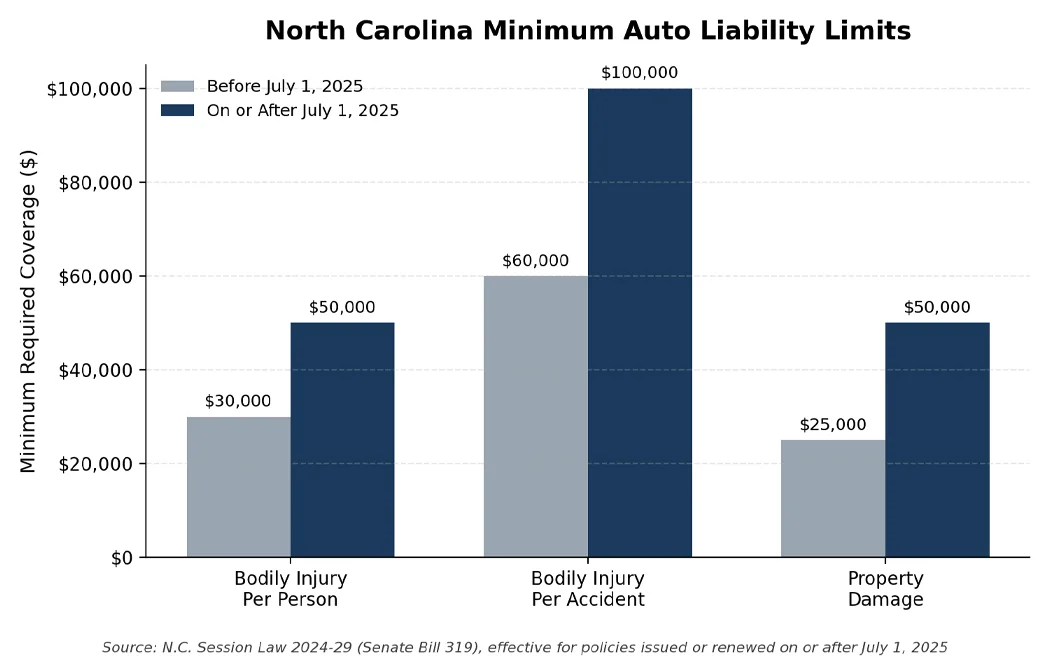
Figure 2. North Carolina minimum auto liability insurance limits, before and after July 1, 2025.
In practical terms, this means the at-fault driver’s insurer now must make available at least $50,000 per injured person and $100,000 total per accident for bodily injury, plus $50,000 for property damage. The change also expanded underinsured motorist coverage requirements so that policies at the new minimum automatically include broader protection if the other driver’s coverage still falls short. Even with higher minimums, a serious Charlotte crash involving surgery, hospitalization, or long-term care can easily exceed available coverage, which is why identifying every applicable policy, including your own underinsured motorist coverage, is a core part of building a full injury claim.
Source: N.C. Session Law 2024-29 (Senate Bill 319), North Carolina General Assembly.
Uber And Lyft Accidents: A Charlotte-Specific Insurance Puzzle
Rideshare use is heavy in Charlotte, particularly around Uptown, South End, and the entertainment districts near Bank of America Stadium and Spectrum Center, which means rideshare-related crashes are a regular part of Charlotte personal injury practice. North Carolina General Statutes Section 20-280.4 sets out three distinct insurance phases for transportation network company drivers, and which phase applies at the moment of your crash controls how much coverage is available.
- App Off: The driver’s personal auto policy applies, subject to North Carolina’s standard minimum liability limits.
- App On, No Passenger Accepted: The rideshare company must provide at least $50,000 per person, $100,000 per accident, and $50,000 in property damage coverage.
- Passenger Accepted Through Drop-Off: The rideshare company’s policy applies at a much higher level, generally 1 million dollars in combined liability and underinsured motorist coverage.
Because coverage can shift dramatically depending on the app’s status at the exact moment of the crash, insurers sometimes dispute which phase applies in order to push a claim toward a lower coverage tier. Pulling the driver’s trip data and app logs quickly after a rideshare accident is often necessary to lock in the correct, higher level of coverage before that data becomes harder to obtain.
Source: N.C. Gen. Stat. § 20-280.4.


Types Of Compensation Available After A Charlotte Accident
North Carolina law allows injured people to recover both economic and non-economic damages, and understanding the difference helps you and your attorney build a complete demand rather than settling for whatever an insurer initially offers.
Economic Damages
- Emergency treatment, hospitalization, surgery, and follow-up care, including future medical needs tied to a permanent injury
- Lost wages from time missed at work, and diminished future earning capacity for more serious injuries
- Property damage to your vehicle or other personal property
- Out-of-pocket costs such as medication, medical equipment, and transportation to appointments
Non-Economic Damages
- Pain and suffering associated with the injury itself
- Emotional distress, including anxiety or trauma connected to the incident
- Loss of enjoyment of life when an injury limits activities you previously engaged in
- Loss of consortium in cases where a spouse’s relationship is affected by the severity of the injury
In rare cases involving especially reckless or intentional conduct, North Carolina law also permits punitive damages, which are intended to punish the wrongdoer rather than compensate the victim directly. These are capped and subject to a higher legal standard than ordinary negligence claims.
The Personal Injury Claim Process In Charlotte
Every case is different, but most Charlotte personal injury claims move through the same general stages. Knowing what to expect helps you make informed decisions at each step, particularly in the days immediately following an accident, when the choices you make can affect your claim for years.
| Stage | What Happens | Why It Matters |
| Medical Treatment | Get evaluated at the scene, an urgent care, or a Charlotte-area emergency room such as Atrium Health Carolinas Medical Center. | Delayed treatment gives insurers an argument that your injury wasn’t serious or related to the accident. |
| Initial Investigation | Your attorney gathers the police report, photographs, witness statements, and preserves evidence such as vehicle data or surveillance footage. | Evidence disappears quickly. Skid marks fade, footage gets overwritten, and witnesses become harder to reach. |
| Insurance Notification | Your own carrier and the at-fault driver’s insurer are notified, ideally through counsel rather than a recorded statement. | Under contributory negligence, an unguarded statement can hand the adjuster a complete defense. |
| Treatment And Documentation | You continue medical care while your attorney compiles bills, records, and lost wage documentation. | Settlement value depends on a complete, well-documented picture of your damages, not just the initial diagnosis. |
| Demand And Negotiation | Once treatment stabilizes, you send a demand package to the insurer and begin negotiations. | A well-supported demand, backed by a lawyer prepared to file suit, produces stronger offers than an unrepresented claim. |
| Filing Suit If Necessary | If negotiations stall, we file a complaint in Mecklenburg County District or Superior Court, depending on the claim value. | North Carolina’s three-year statute of limitations makes this deadline non-negotiable in nearly every case. |
| Resolution | Most cases settle before trial, but we prepare each case as though it will go before a jury. | Insurers negotiate harder when they know the attorney across the table is ready and willing to try the case. |
Where You Will Recover: Charlotte’s Level I Trauma Center
Atrium Health Carolinas Medical Center, located at 1000 Blythe Boulevard in Charlotte, is the only Level I Trauma Center in the entire Charlotte region. Level I status means the hospital maintains twenty-four-hour, in-house coverage by fellowship-trained trauma surgeons and immediate access to neurosurgery, orthopedic surgery, and critical care, the highest tier of trauma readiness recognized by the American College of Surgeons. Many of the more serious injury claims The Watson Law Office handles begin with treatment at this facility or at one of the region’s Level II or III trauma centers, which stabilize patients before transferring the most critical cases to Carolinas Medical Center.
Novant Health Presbyterian Medical Center, located at 200 Hawthorne Lane near Uptown Charlotte, operates as the region’s Level II Trauma Center, also verified by the American College of Surgeons, and frequently treats serious injury cases alongside Carolinas Medical Center. Which hospital treats you can affect how your medical records are organized and requested, so identifying the correct facility early helps your attorney build a complete record of your treatment without unnecessary delay.
Source: Atrium Health; Novant Health; American College of Surgeons trauma center verification standards.
Where Your Case Is Heard: The Mecklenburg County Courthouse
Personal injury lawsuits filed in Charlotte are heard at the Mecklenburg County Courthouse, located at 832 East Fourth Street, Charlotte, North Carolina 28202. Depending on the claim’s value, a case is filed in Mecklenburg County District Court or Superior Court. The Civil Division of the Clerk of Superior Court’s office is open Monday through Friday from 9 a.m. to 5 p.m., and the main line for civil filings is (704) 686-0400. Public parking for court visitors is available at the Fourth Street Parking Deck at the intersection of Fourth and McDowell Streets.
Source: North Carolina Judicial Branch, Mecklenburg County Courthouse.
Settling Your Claim Versus Filing Suit
Most Charlotte personal injury claims resolve through negotiation, but understanding the trade-offs between a negotiated settlement and a filed lawsuit helps set realistic expectations.
| Factor | Negotiated Settlement | Filed Lawsuit |
| Timeline | Typically resolves in a few months once treatment concludes | Can take a year or more, depending on the Mecklenburg County court calendar |
| Cost | Lower out-of-pocket litigation expense | Filing fees, depositions, and expert costs apply |
| Certainty | Both sides agree to a fixed amount | Outcome is decided by a judge or jury and carries more uncertainty |
| Public Record | Confidential in most cases | Court filings and proceedings are part of the public record |
| Leverage | Insurer may lowball if you appear unwilling to litigate | Filing suit signals you are prepared to go the distance, often increasing settlement offers |
Charlotte Personal Injury Facts At A Glance
| Metric | Figure | Source |
| Total Charlotte crashes, 2025 | 38,400 | CMPD Traffic Safety Unit / NCDOT |
| Injury crashes, 2025 | 4,950 | CMPD Traffic Safety Unit / NCDOT |
| Traffic fatalities, 2025 | 176 | CMPD Traffic Safety Unit / NCDOT |
| Average crashes per day | Approximately 105 | CMPD Traffic Safety Unit / NCDOT |
| Highest-collision intersection | Sugar Creek Road at North Tryon Street (66+ crashes) | NCDOT Crash Data Portal |
| Statute of limitations, personal injury | 3 years from date of injury | N.C. Gen. Stat. § 1-52(5) |
| Statute of limitations, wrongful death | 2 years from date of death | N.C. Gen. Stat. § 1-53 |
| Minimum auto liability limits (current) | $50,000 / $100,000 / $50,000 | N.C. Session Law 2024-29 (SB 319) |
| Region’s only Level I Trauma Center | Atrium Health Carolinas Medical Center | American College of Surgeons |
Frequently Asked Questions
Common Concerns Before Calling A Lawyer
I Am Worried About The Cost Of Hiring An Attorney
Personal injury cases at The Watson Law Office are handled so you owe no attorney fee unless money is recovered on your behalf. A free consultation lets you understand your options with no upfront financial commitment.
The Insurance Company Already Offered Me A Settlement
Early settlement offers are often calculated before the full extent of your injuries and future medical needs are known. Once you sign a release, you generally cannot ask for more money later, even if your condition worsens. Reviewing an offer before accepting it costs you nothing and can prevent a costly mistake.


I Do Not Want To Go To Court
The large majority of Charlotte personal injury claims resolve without a trial. Filing a lawsuit does not mean your case will end up in front of a jury. It often simply signals to the insurance company that you are serious, which can move negotiations forward.
It Has Been A While Since My Accident
North Carolina’s three-year statute of limitations means you may still have time to pursue a claim, but the deadline is firm, and case preparation takes time. Contacting an attorney sooner rather than later protects your options.
What Happens When You Call The Watson Law Office
When you call (704) 885-5025, you will speak with a member of The Watson Law Office team, not an automated system. You will be asked basic details about your accident, your injuries, and any insurance communications you have already had. There is no cost and no obligation for this initial conversation. If your situation is a good fit for the firm, you will be scheduled for a consultation with Attorney Kyle T. Watson directly, where you can ask questions and get a clear picture of your legal options before deciding how to proceed.
