

A Charlotte dog bite lawyer helps injured victims pursue compensation from a dog owner under North Carolina’s mix of strict liability and negligence-based dog bite law. North Carolina holds the owner of a legally designated dangerous dog automatically liable for injuries, but most dog bite claims still turn on whether the owner knew or should have known the dog could be dangerous, sometimes called the one-bite rule. The Watson Law Office offers a free case review at (704) 885-5025.
A serious dog attack can leave lasting scars, both physical and emotional, and the legal path to compensation depends heavily on facts many victims never think to gather in the chaos immediately after a bite: whether the dog had bitten before, whether it was legally required to be leashed, and whether the required rabies quarantine and reporting steps were properly followed. North Carolina’s general rules, including its pure contributory negligence standard and three-year filing deadline, covered on our personal injury overview page, still apply, but dog bite claims add a distinct body of animal control law layered on top.

North Carolina’s Three Paths To Recovery At A Glance
| Legal Theory | What You Must Prove | Applies When |
| Strict Liability, Dangerous Dog | The dog met the legal definition of a dangerous dog and caused your injury | N.C. Gen. Stat. § 67-4.1’s definition is met, such as a prior severe injury or an official dangerous dog determination |
| One-Bite Rule (Negligence) | The owner knew or should have known of the dog’s aggressive tendencies | The dog has not been legally declared dangerous, but showed prior warning signs |
| Negligence Per Se, Leash Violation | A local leash or restraint ordinance was violated and contributed to the bite | The dog was off leash or otherwise unrestrained in violation of local law at the time of the attack |
| Strict Liability, Running At Large At Night | The dog was over six months old and intentionally, knowingly, and willfully allowed to run at large at night | The attack occurred at night, and the dog was unsupervised in violation of N.C. Gen. Stat. § 67-12 |
North Carolina’s Three Paths To Recovery
North Carolina recognizes three separate legal theories a dog bite victim can use to recover compensation, and more than one can apply to the same case.
Strict Liability For Dangerous Dogs
Under North Carolina General Statutes Section 67-4.4, the owner of a legally designated dangerous dog is strictly liable in civil damages for any injury or property damage the dog causes. Strict liability means you do not have to prove the owner was careless. You only have to prove the dog met the legal definition of a dangerous dog and that it caused your injury. This is a meaningfully lower burden than the negligence-based theories described below, which is why correctly identifying whether a dog has been, or should have been, classified as dangerous is often one of the first questions worth investigating.
North Carolina General Statutes Section 67-4.1 defines a dangerous dog as one that has, without provocation, killed or inflicted severe injury on a person, or that a county or municipal animal control authority has determined to be potentially dangerous based on specific behaviors, including biting a person and causing a disfiguring laceration, a broken bone, or an injury requiring hospitalization or cosmetic surgery, or approaching a person off the owner’s property in a vicious or terrorizing manner. Dogs kept or trained for dog fighting also qualify. Owners of dogs classified as dangerous who fail to keep them securely confined, or who take them off the property without a leash and muzzle, commit a misdemeanor, which becomes more serious if an attack causes injuries costing more than 100 dollars to treat.
Source: N.C. Gen. Stat. §§ 67-4.1, 67-4.4.
The One-Bite Rule For Other Dogs
For a dog not legally declared dangerous, North Carolina courts apply a version of the scienter, or one-bite, rule. Under this rule, an owner is liable for a bite only if they knew, or reasonably should have known, that the dog had dangerous or aggressive tendencies. This knowledge can come from a prior bite, but it does not have to. Growling at strangers, lunging at the fence, snapping at visitors, or a documented history of aggressive behavior can all support a claim even if the dog never actually bit anyone before your injury. Witness testimony from neighbors, delivery workers, or previous visitors to the property is often the most persuasive evidence available to establish what an owner actually knew before the attack that injured you.
Negligence Per Se From Leash Law Violations
Most North Carolina cities and counties, including Charlotte and Mecklenburg County, require dogs to be leashed or otherwise restrained in public. When an owner violates a local leash ordinance and that violation contributes to a bite, the violation itself can serve as negligence per se, meaning the violation establishes the owner’s negligence without a separate showing of carelessness. This theory can apply even to a dog with no prior history of aggression, since the claim rests on the leash violation itself rather than on what the owner knew about the dog’s temperament.
Strict Liability For Dogs Running At Large At Night
North Carolina General Statutes Section 67-12 creates a separate strict liability rule for dogs over six months old that owners intentionally, knowingly, or willfully allow to run at large at night without the owner or someone designated by the owner present. If a dog violates this rule and injures someone as a result, the owner is strictly liable for the resulting injuries and property damage, and can also be charged with a misdemeanor. This is one of the narrower strict liability rules in North Carolina dog bite law, but it can matter considerably in a case involving a nighttime attack by a dog that had otherwise shown no prior aggression.
Source: N.C. Gen. Stat. § 67-12.
Mandatory Reporting And The 10-Day Quarantine
North Carolina General Statutes Section 130A-196 requires that any dog bite be reported immediately to the local health director, and the statute places this reporting duty on the bitten person, the dog’s owner, and any treating physician alike. Every dog that bites a person must be confined for 10 days, regardless of the dog’s vaccination status, so it can be monitored for signs of rabies. Depending on the circumstances and the dog’s vaccination history, Charlotte-Mecklenburg Animal Care and Control may allow the quarantine to occur at the owner’s home or require it to take place at a veterinary hospital or the county shelter. An owner who fails to comply with the confinement requirement is guilty of a Class 2 misdemeanor.
This reporting requirement matters for more than public health reasons. The animal control investigation and quarantine paperwork it generates often become important documentary evidence in a dog bite claim, including confirmation of the dog’s bite history, its owner’s identity, and whether animal control had prior records involving the same animal. Requesting these records early, before they age out of routine retention schedules, is a practical step that can meaningfully strengthen a Charlotte dog bite claim.
Source: N.C. Gen. Stat. § 130A-196; Charlotte-Mecklenburg Police Department Animal Care and Control.
The Financial Scale Of Dog Bite Claims Nationally
Dog bite injuries have grown more expensive to treat and to resolve legally in recent years. According to the Insurance Information Institute and State Farm, U.S. insurers paid out approximately $1.57 billion in dog-related injury claims in 2024 across 22,658 claims, an increase of nearly 19 percent in claim volume from 2023.
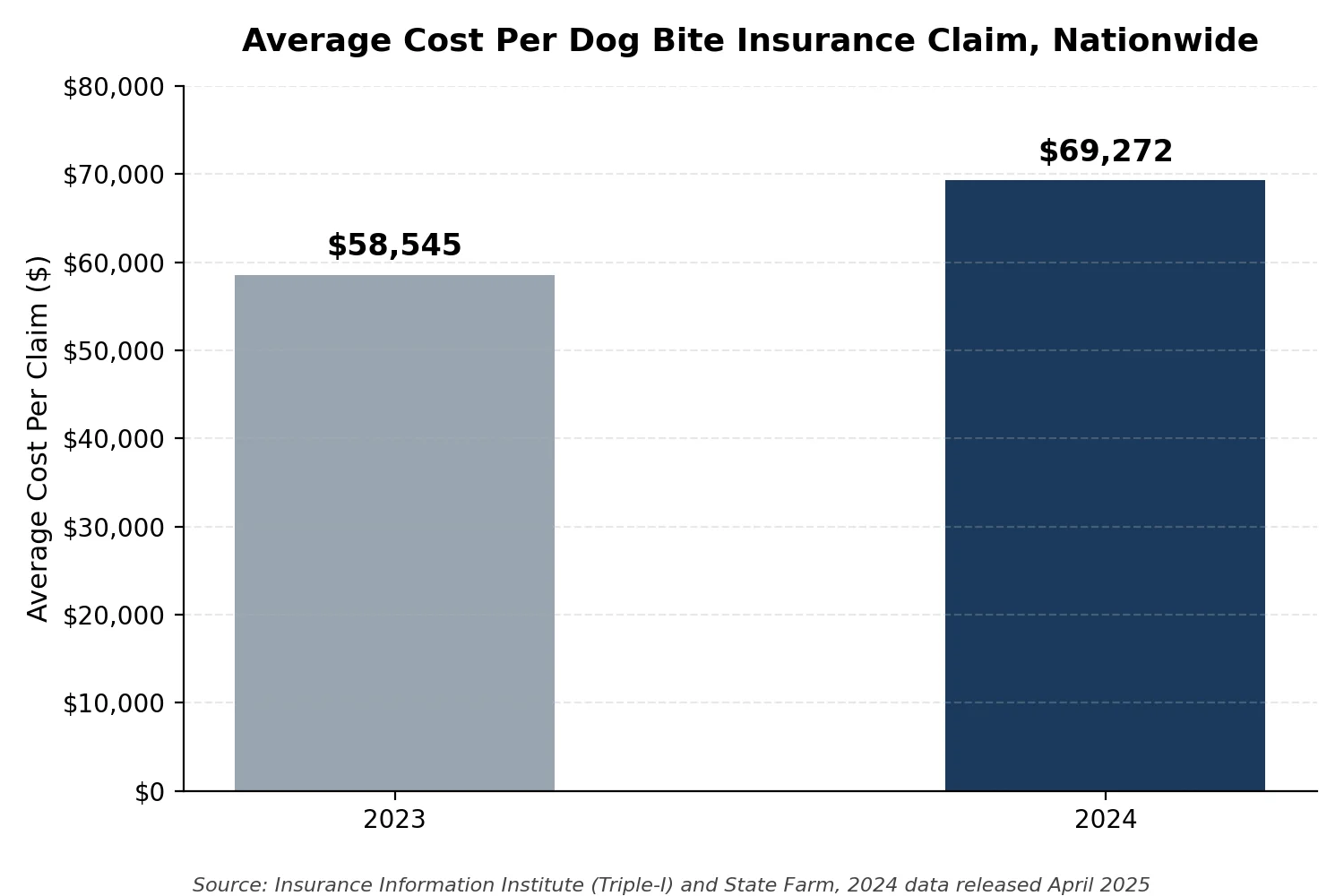
Figure 1. Average cost per dog bite insurance claim, nationwide, 2023 to 2024.
The average cost per claim rose from $58,545 in 2023 to $69,272 in 2024, an 18 percent single-year increase driven largely by rising medical costs and larger settlements and verdicts. These figures reflect national averages rather than a prediction of what any individual Charlotte case is worth, since a specific claim’s value depends on the injury’s severity, the applicable legal theory, and the insurance coverage available.
Source: Insurance Information Institute (Triple-I) and State Farm, data released April 2025.
Who Can Be Held Responsible Beyond The Dog’s Owner
- A landlord who knew a tenant’s dog had dangerous propensities and had the ability to have it removed from the property
- A dog sitter, walker, or boarding facility that had custody and control of the dog at the time of the attack
- A property owner or business that allowed a known dangerous dog on the premises without adequate precautions
- A parent or guardian in certain circumstances involving a minor’s dog, depending on ownership and control of the animal
Landlord liability claims deserve particular attention in a rental-heavy market like Charlotte. North Carolina courts generally require a showing that the landlord had actual knowledge of a tenant’s dangerous dog, along with the practical ability to have the animal removed under the lease, before liability attaches. A landlord who received prior complaints about a tenant’s dog, particularly complaints documented in writing or through a property management system, faces a much stronger claim than one with no prior notice.
Identifying every potentially responsible party matters because it can open access to additional insurance coverage, particularly homeowners or renters insurance policies, which pay most dog bite settlements in North Carolina.
Children Are Disproportionately Affected By Dog Bites
National data from the American Veterinary Medical Association and the Centers for Disease Control and Prevention consistently show that children face the highest risk of serious dog bite injury, both because of their smaller size relative to a dog and because young children are less able to recognize warning signs of aggression before an attack occurs.


Bites to the face, head, and neck are disproportionately common in child victims, reflecting the difference in height between a young child and most dogs. These same factors mean that a Charlotte case involving a child victim often requires particular attention to long-term scarring, potential reconstructive treatment, and the psychological impact of the attack as the child grows older. A settlement or verdict involving a minor also typically requires court approval in North Carolina to ensure the compensation is properly protected until the child reaches adulthood.
Common Charlotte Dog Bite Scenarios
- Delivery drivers and mail carriers bitten while approaching a home or apartment, often in areas without a visible warning sign
- Attacks at Charlotte’s dog parks, where owners sometimes lose control of multiple animals in an off-leash environment
- Bites occurring in shared spaces of apartment complexes and condominium developments, where property management may share responsibility if a dangerous dog was known and not addressed
- Attacks on visitors or guests inside a private home, which are typically covered by the homeowner’s insurance policy
- Bites involving a neighbor’s dog that escaped through a broken fence or an open gate
- Repeat incidents involving the same animal, where prior animal control records can be decisive in establishing an owner’s knowledge of the dog’s temperament
Homeowners And Renters Insurance Considerations
Most dog bite settlements are ultimately paid through the dog owner’s homeowners or renters insurance policy rather than out of pocket. This makes insurance coverage, not just legal liability, a central practical question in any Charlotte dog bite claim. Some insurers exclude certain breeds entirely, some policies exclude a dog after it has been involved in a prior bite, and some homeowners underestimate their coverage limits compared with the potential cost of a serious attack.
Identifying what coverage actually exists, and whether any exclusions apply, is frequently one of the first and most consequential steps in evaluating a Charlotte dog bite claim. When a homeowner’s policy excludes coverage entirely, an injured victim may still need to pursue the claim directly against the owner’s personal assets, which changes both the strategy and the realistic timeline for recovery.
Common Injuries In Charlotte Dog Bite Cases
- Deep puncture wounds and lacerations, often requiring stitches, staples, or surgical repair
- Nerve and tendon damage, particularly in bites to the hands, arms, or legs
- Facial injuries and disfiguring scarring, especially common in attacks on young children
- Infections, including bacterial infections that can develop even after a wound is properly cleaned and treated
- Psychological trauma, including a lasting fear of dogs that can persist long after physical wounds have healed
Frequently Asked Questions
Common Concerns Before Calling A Dog Bite Lawyer
I Do Not Want To Get My Neighbor Or Their Dog In Trouble
This is a common and understandable concern, but pursuing compensation for your injuries is a separate question from what happens to the dog. In most cases, a claim is resolved through the owner’s insurance policy rather than a personal payment, and it does not automatically result in the dog being euthanized or removed.
The Dog Has Never Bitten Anyone Before
A first bite does not automatically end your claim. If the owner knew or should have known about aggressive tendencies, or if a leash law was violated, you may still have a strong case under North Carolina law.


I Was Bitten While On The Owner’s Property
Being on the owner’s property does not automatically bar a claim, though the specific circumstances, including whether you were invited and whether any warning signs were posted, can affect the analysis. This is exactly the kind of fact pattern worth having reviewed by an attorney rather than assumed.
What Happens When You Call The Watson Law Office
When you call (704) 885-5025, a member of the Watson Law Office team will ask about the attack, your injuries, and whether the dog has any known history with animal control. This conversation is free and carries no obligation. If your case is a good fit, you will be scheduled for a consultation with Attorney Kyle T. Watson, who can help you understand which of North Carolina’s legal theories apply to your situation and what insurance coverage may be available. Bring any animal control paperwork, photographs of your injuries, and the contact information of any witnesses so the consultation can move directly into evaluating your options.
