

A Charlotte motorcycle accident lawyer helps injured riders pursue compensation from an at-fault driver after a crash, while pushing back against the biased assumptions insurance companies often bring to motorcycle claims. Motorcyclists face a far higher risk of death or serious injury than car occupants in a crash of comparable severity, and North Carolina law includes specific protections, such as its helmet statute’s built-in negligence disclaimer, that many riders do not know exist. The Watson Law Office offers a free case review at (704) 885-5025.
What most don’t know is that Attorney Kyle T. Watson is an avid motorcycle rider himself and has been for many years. He has also been involved in a catastrophic motorcycle accident, requiring multiple surgeries, and had to fight against the insurance companies himself while he lay in the hospital for weeks, thereafter managing an 18-month recovery. Within weeks of his accident, he was able to recover the maximum amount of money available from the insurance company for his injuries. Attorney Watson knows what it’s like to be severely injured, and what it’s like to go up against the insurance companies to get the compensation deserved.

Attorney Watson
Insurance adjusters often assume a motorcyclist was speeding, weaving, or otherwise reckless before a crash even happened. That bias isn’t supported by the facts in most cases, and North Carolina law doesn’t allow several of the more common tactics adjusters use against riders. The general rules covered on our personal injury overview page, including North Carolina’s pure contributory negligence standard and three-year filing deadline, apply to motorcycle claims, but riders face a distinct set of legal issues, from helmet law to lane position, that a car accident case never raises.
Why Motorcyclists Face Disproportionate Risk On Charlotte Roads
The physics of a motorcycle crash are fundamentally different from a car accident, and national data makes the gap stark. According to the National Highway Traffic Safety Administration’s 2024 Traffic Safety Facts, the fatality rate for motorcyclists was 28.00 per 100 million vehicle miles traveled, compared to just 1.05 for passenger car occupants, a rate almost 27 times higher. Motorcyclists were also involved in an estimated 86,887 injuries nationwide in 2024, up 5.2 percent from the previous year.
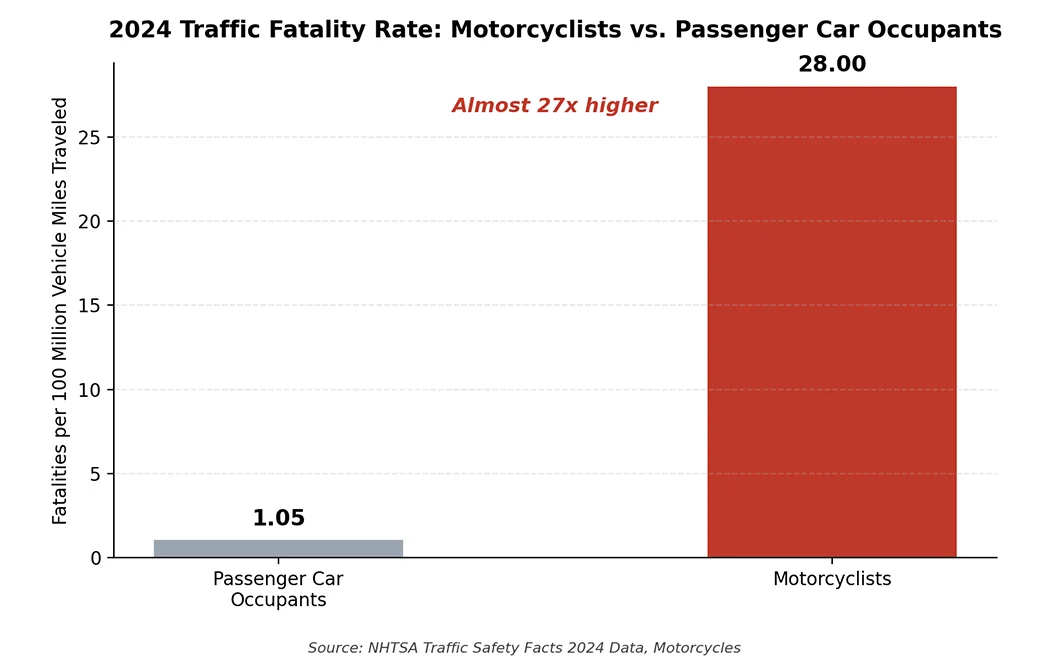
Figure 1. 2024 traffic fatality rate, motorcyclists versus passenger car occupants.
Source: NHTSA Traffic Safety Facts 2024 Data, Motorcycles.
North Carolina’s own numbers reflect the same pattern. The state’s official 2024 Crash Facts report recorded 193 motorcyclists killed, a 4 percent decrease from 2023, alongside 3,255 motorcyclists injured, a 3.0 percent increase over the same period.
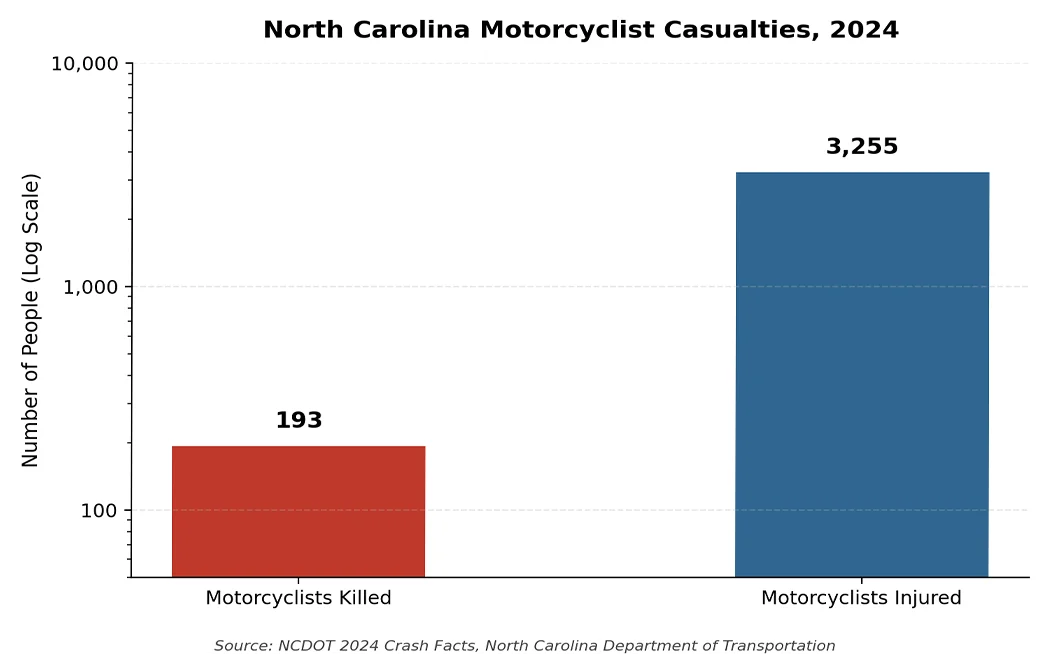
Figure 2. North Carolina motorcyclist casualties, 2024.
Source: NCDOT 2024 Crash Facts, North Carolina Department of Transportation.
National data also complicates the assumption that riders themselves are usually to blame. NHTSA’s 2024 figures show that 35 percent of motorcycle riders in fatal crashes had no valid motorcycle license, but alcohol impairment among motorcycle riders in fatal crashes, at 25 percent, was identical to the rate among passenger car drivers and far higher than the 4 percent rate for large truck drivers. These figures cut against the common assumption that motorcyclists are categorically less careful than other drivers, and they underscore why each crash needs its own independent investigation rather than a generic assumption about riders.
Source: NHTSA Traffic Safety Facts 2024 Data, Motorcycles.
Why So Many Motorcycle Crashes Involve A Driver Who Simply Did Not See The Rider
A recurring pattern in motorcycle crash investigations is the driver who insists, often honestly, that they never saw the motorcycle before impact. A motorcycle’s narrow visual profile, combined with a driver’s tendency to scan for the wider shapes of cars and trucks, means motorcyclists are disproportionately involved in the same left-turn and intersection collisions covered in detail on our car accident page. The right-of-way rules described there, including a left-turning driver’s duty to yield to oncoming traffic, apply identically to a motorcycle, but proving what a driver could and should have seen is often the central factual dispute in a motorcycle case in a way it rarely is in a car-to-car collision.
North Carolina law favors an injured rider on this point. Under North Carolina General Statutes Section 20-129, every motorcycle must have its headlamp and taillamp lighted at all times while operating on a highway or public vehicular area, day or night, and operating without these lights on is negligence in itself under North Carolina’s pattern jury instructions. In practice, this means that if your motorcycle had its required lighting on, as it almost always is by design and by habit among riders, a driver’s claim that the motorcycle was simply invisible carries far less weight than it might first appear.

Source: N.C. Gen. Stat. § 20-129; N.C.P.I.-Motor Vehicle 215.16.
Common Types Of Charlotte Motorcycle Accidents
Beyond left-turn and intersection crashes, several other collision patterns show up repeatedly in Charlotte motorcycle claims.
- Rear-end collisions, often caused by a driver underestimating how quickly a motorcycle can slow or stop compared to a car
- Sideswipe and lane-change collisions, where a driver fails to check a blind spot before merging into a motorcycle’s lane
- Dooring incidents, where a parked car’s door opens directly into a rider’s path, a particular risk on street-parking corridors in areas like NoDa and Plaza Midwood
- Fixed-object and road-hazard crashes, where a pothole, loose gravel, or uneven pavement destabilizes the motorcycle without any other vehicle involved
- Rear passenger ejection crashes, where a sudden stop or impact throws a passenger from the motorcycle separately from the operator, sometimes resulting in a distinct injury pattern and claim
Charlotte’s mix of dense urban corridors and higher-speed suburban connectors means both low-speed and high-speed collision patterns show up regularly in local claims. A low-speed dooring or lane-change crash in South End can still produce a serious fracture, while a high-speed rear-end or sideswipe collision on outer Interstate 485 tends to produce the catastrophic injuries associated with greater speed differentials. Identifying which pattern applies to your crash shapes both the liability analysis and the realistic scope of damages from the outset.
What To Do After A Charlotte Motorcycle Accident
Many of the same steps that apply after any Charlotte crash, covered in more detail on our car accident page, apply here as well, including calling 911, getting a CMPD crash report, and avoiding a recorded statement before speaking with an attorney. Motorcycle claims add one consideration that a car accident never raises: your gear.
Do not clean, repair, or discard your helmet, jacket, gloves, or riding boots after a crash, even if they are damaged or covered in road debris. Insurance adjusters frequently examine a helmet’s impact pattern and a jacket’s abrasion marks to evaluate the crash mechanics and the force involved. Damaged gear that gets thrown away at the hospital or repaired before it can be photographed is evidence you can’t recover later. If possible, ask a family member or friend to collect and store your gear exactly as it was after the crash until your attorney has reviewed it.
North Carolina’s Helmet Law And What It Does Not Mean For Your Claim
North Carolina has one of the strictest motorcycle helmet laws in the country. Under North Carolina General Statutes Section 20-140.4(a)(2), every operator and passenger on a motorcycle or moped must wear, on their head with the retention strap properly secured, a safety helmet that complies with Federal Motor Vehicle Safety Standard 218. Unlike many states, North Carolina applies this requirement to riders of every age, with no exception for adult riders.
What surprises many injured riders, and many insurance adjusters hope they never learn, is that the same statute contains an explicit protection. North Carolina General Statutes Section 20-140.4(b) states plainly that a violation of the helmet law shall not be considered negligence per se or contributory negligence per se in any civil action. Subsection (d) goes further, providing that no driver’s license points or insurance surcharge may be assessed for a helmet violation. In practical terms, this means an insurance company cannot simply point to a missing or improperly worn helmet and declare your claim barred under North Carolina’s contributory negligence rule. The absence of a helmet may still be relevant to how a jury views your damages in some circumstances, but it is not, by itself, a legal bar to recovery.
Source: N.C. Gen. Stat. § 20-140.4(a)(2), (b), (d).
Lane Splitting And Lane Sharing In North Carolina
North Carolina has no statute that directly names lane splitting, the practice of riding between lanes of slow or stopped traffic. In practice, the state’s general traffic laws, which require every vehicle to remain within a single marked lane, make lane splitting unlawful in nearly all circumstances.
Lane sharing is a different practice and is expressly permitted under North Carolina law, allowing two motorcycles to ride side by side within a single lane. If lane splitting is raised as an issue in your case, whether you were doing it or a driver claims you were, how it is characterized can matter a great deal under North Carolina’s contributory negligence rule, making early legal guidance especially important.
Common Injuries In Charlotte Motorcycle Accidents
Without the structural protection of a car’s frame, airbags, and seatbelt, a motorcyclist absorbs crash forces directly. Injuries that would be minor in a car accident are frequently severe or life-changing in a motorcycle crash.
- Road rash, ranging from superficial abrasions to deep tissue damage requiring skin grafts
- Fractures, particularly to the arms, legs, and collarbone, from impact or from being thrown from the bike
- Traumatic brain injury, even with proper helmet use, given the force involved in most motorcycle crashes
- Spinal cord injury, which can result in partial or complete paralysis
- Lower extremity injuries, including degloving injuries and traumatic amputation, common when a leg is trapped between the motorcycle and another vehicle or the roadway
Charlotte Road Hazards That Affect Motorcycles Differently Than Cars
A hazard that a car’s suspension and four-point contact with the road absorb without incident can be catastrophic for a two-wheeled vehicle. Potholes, uneven pavement transitions, loose gravel, and construction debris, all common on Charlotte’s older residential streets and its heavily trafficked construction corridors, pose a disproportionate risk to motorcyclists. Railroad crossings and metal grate surfaces can also destabilize a motorcycle in a way that has no equivalent for a passenger vehicle.
When a hazardous road condition contributes to a crash, liability may extend beyond the other driver to the government entity or contractor responsible for maintaining that stretch of road, a claim that carries its own separate notice deadlines and procedural requirements distinct from an ordinary negligence claim.
Insurance Considerations Unique To Motorcycle Claims
North Carolina requires the same minimum liability insurance for motorcycles as for any other motor vehicle. Because motorcycle crash injuries are so often severe, the gap between a minimum insurance policy and the actual cost of treatment tends to be wider than in an average car accident case.
The underinsured motorist coverage principles described on our personal injury overview page apply with particular force here, since a rider’s own medical costs frequently exceed the minimum limits carried by the driver who caused the crash. Reviewing your own policy for underinsured motorist coverage, and any separate medical payments coverage carried specifically on the motorcycle policy, is an early step in evaluating what compensation is actually available.
Insurer Assumptions Versus North Carolina Law
The gap between how insurance companies often approach a motorcycle claim and what North Carolina law actually provides is one of the most consistent patterns in these cases.
| Common Insurer Assumption | The Legal Reality In North Carolina |
| No helmet means no case | A helmet violation is not negligence per se or contributory negligence per se under N.C. Gen. Stat. Section 20-140.4(b) |
| The rider was probably speeding | National data shows alcohol impairment rates among motorcyclists and passenger car drivers in fatal crashes are statistically similar, undercutting a blanket assumption of rider recklessness |
| The driver could not have seen the motorcycle | Motorcycles must run headlamps and taillamps at all times under N.C. Gen. Stat. Section 20-129, weakening a driver’s claim that the bike was not visible |
| Lane splitting bars recovery automatically | Whether lane position affected fault still depends on the specific facts, and North Carolina’s contributory negligence rule requires the insurer to prove the rider’s fault, not merely assert it |
Passenger Injury Claims
A motorcycle passenger injured in a crash has legal options that an operator does not always have. North Carolina’s helmet law applies equally to passengers, and the same negligence-disclaimer protection under Section 20-140.4(b) applies if a passenger was not wearing one. Unlike the operator, however, a passenger may have a claim against the motorcycle’s own operator, in addition to any other driver involved, if the operator’s own negligence, such as excessive speed or improper lane position, contributed to the crash.


This adds a layer of insurance analysis a solo-rider claim does not involve, since the operator’s own liability coverage may become a source of recovery for an injured passenger. A passenger’s claim is also unaffected by any argument about the operator’s own conduct in choosing to ride that day, since a passenger did not control the motorcycle and is not automatically bound by allegations made against the person operating it.
Frequently Asked Questions
Common Concerns Before Calling A Motorcycle Accident Lawyer
I Was Not Wearing A Helmet, So I Assume I Have No Case
This is one of the most common and most damaging misconceptions among injured riders. North Carolina law explicitly prevents a helmet violation from automatically defeating your claim. Whether you were wearing a helmet is a separate question from whether the other driver was negligent.
I Was Told Motorcyclists Never Win These Cases In North Carolina
North Carolina’s contributory negligence rule makes any personal injury case more challenging than in most states, but it applies the same way to a motorcycle claim as to a car accident claim. The key is a thorough investigation that anticipates and answers the specific arguments an insurer is likely to raise against a rider.


The Police Report Blames Me For The Crash
A responding officer’s initial assessment is not the final word on fault, and officers sometimes bring the same unconscious bias against motorcyclists that insurance adjusters do. An independent investigation, including physical evidence and witness accounts, can tell a different story than the initial report.
What Happens When You Call The Watson Law Office
When you call (704) 885-5025, a member of the Watson Law Office team will ask about your accident, your injuries, and any contact you have already had with an insurance company. This conversation is free and carries no obligation. If your case is a good fit, you will be scheduled for a consultation with Attorney Kyle T. Watson, who can help you understand how North Carolina’s helmet law, lane rules, and contributory negligence standard apply to your specific situation. Bring your gear, your CMPD crash report if you have it, and any photographs or documentation you have already gathered so the consultation can move directly into evaluating your options.
