

A Charlotte pedestrian accident lawyer helps people struck by a vehicle while walking pursue compensation from the driver, and in some cases from the City of Charlotte itself when a defective sidewalk or crosswalk contributed to the crash. North Carolina law gives pedestrians specific crosswalk protections, and it does not treat crossing outside a crosswalk as an automatic bar to recovery the way many insurance adjusters suggest. The Watson Law Office offers a free case review at (704) 885-5025.
Pedestrian crashes raise a mix of legal issues that do not come up in a typical two-vehicle collision. North Carolina’s general rules, including its pure contributory negligence standard and three-year filing deadline, covered on our personal injury overview page, still apply, but pedestrian claims add a body of crosswalk and right-of-way law, and sometimes a claim against a government entity with its own separate notice deadline, that make early legal guidance especially valuable.

Pedestrian Right-Of-Way At Crosswalks
North Carolina General Statutes Section 20-173(a) requires a driver to yield the right of way, slowing down or stopping if necessary, to a pedestrian crossing within a marked crosswalk or an unmarked crosswalk at or near an intersection, whenever traffic signals are not controlling that crossing. An unmarked crosswalk is not just any spot near an intersection. North Carolina courts have defined it specifically as the area that would be covered if the lines of an existing sidewalk were extended straight across the intersection.
Two related rules extend this protection further. Section 20-173(b) prohibits a driver from passing another vehicle that has stopped at a crosswalk to let a pedestrian cross, closing off a common and dangerous maneuver. Section 20-173(c) requires a driver entering or exiting an alley, building entrance, private road, or driveway to yield to a pedestrian or cyclist crossing on a sidewalk that extends across that entrance, which comes up frequently in Charlotte’s shopping center and apartment complex parking lots. Each provision targets a distinct danger point rather than restating a single general rule, giving an injured pedestrian several independent legal theories to examine depending on how the crash unfolded.
Source: N.C. Gen. Stat. § 20-173(a), (b), (c); Anderson v. Carter, 272 N.C. 426 (1968).
What Happens At A Signalized Intersection
Where an intersection has a pedestrian signal displaying WALK or DON’T WALK, North Carolina General Statutes Section 20-172(b) requires pedestrians to obey it. A pedestrian who begins crossing on a WALK signal has the right of way, and drivers must yield accordingly.
A pedestrian already in the roadway when the signal changes to DON’T WALK is permitted to continue to a sidewalk or safety island rather than being stranded mid-crossing. Where an intersection has traffic signals but no separate pedestrian signal, Section 20-172(c) requires pedestrians to follow the vehicle signals as they apply to pedestrian movement. A turning vehicle, including one making a right turn on red under the rules described on our car accident page, must still yield to a pedestrian lawfully in a marked or unmarked crosswalk.
Source: N.C. Gen. Stat. § 20-172(b), (c).
Crossing Outside A Crosswalk Does Not Automatically Bar Your Claim
Perhaps the most common misconception in a Charlotte pedestrian case is the belief that crossing mid-block, sometimes called jaywalking, automatically defeats a claim. North Carolina General Statutes Section 20-174(a) does require a pedestrian crossing outside a marked or unmarked crosswalk to yield to vehicles on the roadway, and Section 20-174(d) similarly requires a pedestrian walking along a roadway without a sidewalk to walk facing traffic and yield the right of way. But North Carolina courts have held consistently, in cases stretching back decades, that a pedestrian’s failure to yield under these sections is not contributory negligence per se. It is only evidence of negligence to be weighed along with everything else in the case.
Just as important, Section 20-174(e) imposes an independent, affirmative duty on every driver: regardless of whether a pedestrian yielded properly, a driver must exercise due care to avoid colliding with any pedestrian on a roadway, sound the horn when necessary, and exercise particular precaution upon observing a child or a confused or incapacitated person in the roadway. This duty exists on top of, not instead of, the pedestrian’s own obligations, which means a pedestrian who was technically outside a crosswalk can still have a strong claim if the driver failed to keep a proper lookout or take reasonable evasive action.
Source: N.C. Gen. Stat. § 20-174(a), (d), (e); Blake v. Mallard, 262 N.C. 62 (1964); Hofecker v. Casperson, N.C. Ct. App. (2005).
School Zones And The Heightened Duty Toward Children
North Carolina General Statutes Section 20-141.1 allows local authorities to set school zone speed limits below the ordinary posted limit, enforceable only on days when school is in session and never set below 20 miles per hour. A driver who exceeds a posted school zone speed limit commits an infraction carrying a $250 penalty, a fine the General Assembly increased tenfold from its original $25 amount specifically to strengthen deterrence around schools.


This heightened attention to child safety extends beyond the posted speed limit itself. As described above, North Carolina General Statutes Section 20-174(e) separately requires every driver to exercise particular precaution upon observing a child in the roadway, a standard that applies whether or not the child was inside a marked crosswalk or a posted school zone at the moment of the crash. Together, these provisions mean that a crash involving a child pedestrian near a Charlotte school is evaluated against a materially higher standard of care than an equivalent crash involving an adult in an ordinary residential setting.
Source: N.C. Gen. Stat. §§ 20-141.1, 20-174(e).
Sidewalk Defects And Claims Against The City Of Charlotte
Not every Charlotte pedestrian injury involves a moving vehicle. North Carolina General Statutes Section 160A-296(a)(1) places an affirmative duty on cities to keep public streets, sidewalks, alleys, and bridges in proper repair. When a defective sidewalk causes a fall, North Carolina courts apply a four-part test drawn from Cook v. Burke County: the pedestrian must show they fell and were injured, that a defect in or condition of the sidewalk proximately caused the fall, that the defect was serious enough that a reasonable person should have foreseen injury to someone using the sidewalk properly, and that the city had actual or constructive notice of the defect long enough before the fall to have fixed it or warned about it.
North Carolina courts have also recognized a trivial defect doctrine that can defeat an otherwise valid claim. In Desmond v. City of Charlotte, the North Carolina Court of Appeals held that a sidewalk crack only 1.6 inches deep was trivial as a matter of law, even though the plaintiff’s experts testified the walkway violated applicable safety codes. Older cases have similarly declined to impose liability for cracks up to roughly two inches deep or two feet wide.
This doctrine makes the specific dimensions and history of a sidewalk defect central to whether a Charlotte sidewalk fall claim can succeed. Under North Carolina law, a city also need not clear public sidewalks of ice or snow, which forecloses an entire category of claims that might otherwise seem viable after a winter weather fall.
Source: N.C. Gen. Stat. § 160A-296(a)(1); Cook v. Burke County, 272 N.C. 94 (1967); Desmond v. City of Charlotte, N.C. Ct. App. (2001); Welling v. City of Charlotte, 241 N.C. 312 (1955).
The City Of Charlotte’s Short Notice Deadline
Claims against the City of Charlotte carry a separate and much shorter deadline than an ordinary personal injury claim against a private driver. Under Section 9.01 of the Charlotte City Charter, written notice of a damages claim against the city must generally be provided within 90 days of the injury. The North Carolina Supreme Court has confirmed that this notice requirement will be enforced, though substantial compliance, such as notice delivered to the city manager rather than directly to the city council, has been found sufficient in at least one case.
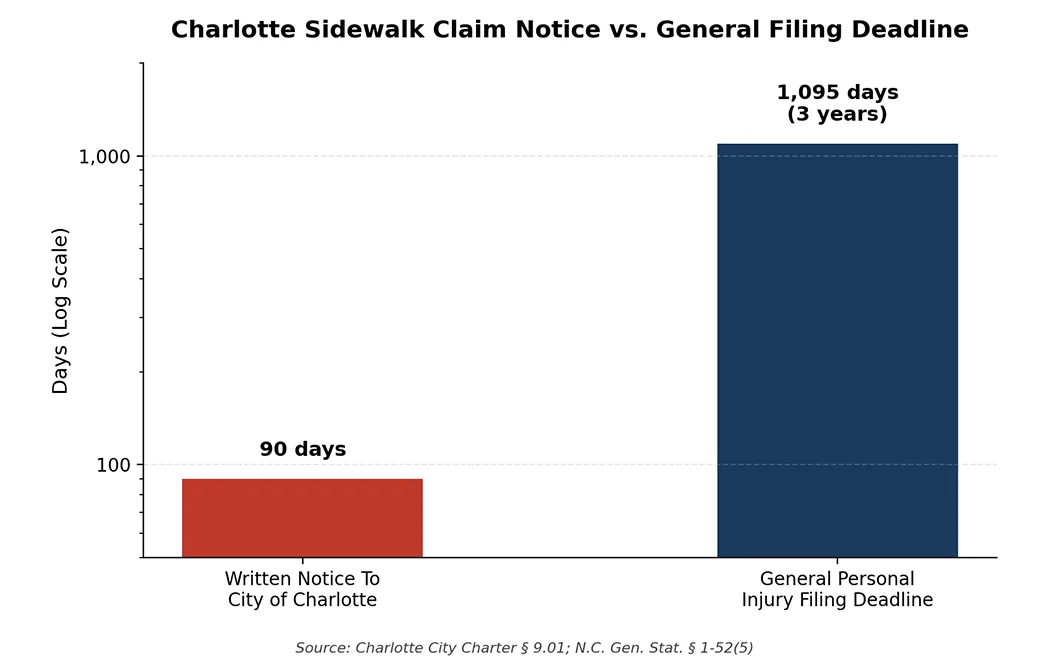
Figure 1. Charlotte’s municipal claim notice deadline compared to the general personal injury filing deadline.
This 90-day window is dramatically shorter than the three-year deadline that applies to an ordinary claim against a private driver, and missing it can permanently bar an otherwise valid claim against the city, regardless of how strong the underlying facts are. Anyone injured by a defective Charlotte sidewalk, street, or public right-of-way should treat that 90-day period as an urgent deadline, not a general guideline. Because the notice must be in writing and directed to the proper city office, a phone call or an informal report to a city employee at the scene may not, by itself, satisfy the requirement.
Source: Charlotte City Charter § 9.01; Miller v. City of Charlotte, 288 N.C. 475 (1975).
North Carolina’s 2024 Pedestrian Crash Data
The state’s official 2024 Crash Facts report recorded 281 pedestrians killed in North Carolina traffic crashes, a 12 percent increase over 2023. The same report found that 11 percent of all pedestrians involved in a motor vehicle crash statewide were killed, reflecting how much less protection a pedestrian has compared to any vehicle occupant in a collision of similar force. While this summary does not isolate Charlotte or Mecklenburg County figures, the county’s overall crash and traffic volume, detailed on our personal injury overview page, makes it one of the areas where pedestrian-involved crashes are documented most often statewide.
Source: NCDOT 2024 Crash Facts, North Carolina Department of Transportation.
Common Types Of Charlotte Pedestrian Accidents
- Crosswalk collisions, where a driver fails to yield to a pedestrian with the right of way at a marked or unmarked crosswalk
- Turning vehicle collisions, where a driver making a left or right turn fails to check for a pedestrian already in the crosswalk
- Parking lot and backing vehicle accidents, common in Charlotte’s shopping centers and apartment complexes
- School zone accidents, involving children crossing near bus stops or crosswalks, where drivers face a heightened duty of care under North Carolina law
- Sidewalk defect falls, where a crack, uneven slab, or poorly maintained crossing causes an injury without any vehicle involved
- Hit-and-run collisions, which raise separate questions about uninsured motorist coverage and, in some cases, a claim against your own policy
Parking lot and backing vehicle incidents deserve particular attention in a city with as much retail and multifamily development as Charlotte. These crashes typically happen at low speed, which can lead both the driver and the pedestrian to underestimate the seriousness of the resulting injury, particularly for older adults or young children who are more vulnerable to fractures from even a low-speed impact.
Because these incidents often occur on private property rather than a public roadway, the property owner’s own maintenance and lighting conditions can sometimes become a relevant factor alongside the driver’s conduct.
Common Injuries In Charlotte Pedestrian Accidents
- Traumatic brain injury and skull fractures from head impact with a vehicle or the pavement
- Lower extremity fractures, particularly to the legs, hips, and pelvis, from direct vehicle impact
- Spinal cord injury, which can result in partial or complete paralysis depending on the severity and location of the injury
- Internal injuries from being struck and thrown, or from being run over after an initial impact
- Multiple fractures and orthopedic injuries requiring surgical repair and extended rehabilitation
Common Insurer Assumptions About Pedestrians Versus North Carolina Law
| Common Insurer Assumption | The Legal Reality In North Carolina |
| The pedestrian was jaywalking, so the claim is barred | Failure to yield outside a crosswalk under N.C. Gen. Stat. Section 20-174(a) is not contributory negligence per se; it is only evidence to be weighed with everything else |
| The pedestrian was outside the crosswalk, so the driver owed no duty | Section 20-174(e) requires every driver to exercise due care to avoid colliding with any pedestrian on a roadway, regardless of where the pedestrian was walking |
| The sidewalk crack was minor, so the city cannot be liable | Minor defects can still support a claim depending on their specific depth, width, and history, though North Carolina’s trivial defect doctrine sets a real limit worth evaluating early |
| There is plenty of time to file a claim against the city | Charlotte’s Charter generally requires written notice within 90 days of the injury, far shorter than the three-year deadline for an ordinary claim against a private driver |
Frequently Asked Questions
Common Concerns Before Calling A Pedestrian Accident Lawyer
I Was Not In A Crosswalk, So I Assume It Was My Fault
This is one of the most common misconceptions in pedestrian cases, and it is not accurate under North Carolina law. Crossing outside a crosswalk is only one factor among many, and the driver’s own conduct is still evaluated independently.
The City Told Me They Already Knew About The Sidewalk Problem
That can actually help your case, since proving the city had notice of a defect is a required element of a sidewalk claim. It does not guarantee success, especially if the defect is minor enough to fall under the trivial defect doctrine, but it is worth evaluating quickly given the short notice deadline.


It Has Been A Few Months Since My Fall On A City Sidewalk
If your claim involves the City of Charlotte specifically, time may already be a serious concern given the 90-day notice requirement. Contact an attorney immediately to determine whether that window has already closed or whether an exception might apply. Even if the notice deadline has passed, it is worth a conversation, since not every pedestrian injury near a sidewalk necessarily depends on a claim against the city itself.
What Happens When You Call The Watson Law Office
When you call (704) 885-5025, a member of the Watson Law Office team will ask about your accident, your injuries, and whether a driver, a property owner, or a government entity like the City of Charlotte may be involved. This conversation is free and carries no obligation. If your case is a good fit, you will be scheduled for a consultation with Attorney Kyle T. Watson, who can help you understand the deadlines that apply to your situation, including any short notice period that may already be running. Bring your medical records, any photographs of the scene or the defect that caused your fall, and the contact information of any witnesses so your consultation can move directly into evaluating what claims and deadlines apply.
