



After a rear-end accident in Charlotte, check for injuries, call 911, and report the crash to the Charlotte-Mecklenburg Police Department. Photograph both vehicles, your brake lights, and the scene, then get medical care even if you feel fine. Avoid giving a recorded statement to the other driver’s insurer until you understand your rights, and speak with a Charlotte car accident attorney about your claim.
Knowing what to do after a rear-end accident in Charlotte can protect both your health and your claim. Many people assume that being hit from behind makes the case simple. In North Carolina, that assumption can be costly, because the insurance company only needs to show you were slightly at fault to try to deny your claim entirely. The steps below explain what to do at the scene, in the days after, and before you ever speak with an adjuster. For a broader look at how these claims work, visit our guide to Charlotte car accidents.
Why Rear-End Accidents Are Not as Simple as They Seem
Rear-end collisions are among the most common crashes on Charlotte roads, especially in the stop-and-go traffic on I-77, I-85, I-485, and Independence Boulevard. The driver in the back is usually responsible because North Carolina law requires drivers to leave enough space to stop safely. But it is not always.
North Carolina is one of only a handful of states that still follows contributory negligence. Under this rule, an injured person who is found even 1 percent at fault can be barred from recovering compensation. Insurance adjusters know this, and in rear-end cases they look for arguments such as a sudden stop without reason, a lane change directly in front of the other driver, or nonfunctioning brake lights. Our page on rear-end accident claims explains how courts decide fault in these cases. The steps below help ensure those arguments don’t stick.
Step 1: Stop, Check for Injuries, and Call 911
North Carolina law requires every driver involved in a crash to stop at the scene. Check yourself and your passengers for injuries, then call 911. If anyone is hurt, or if the crash caused $1,000 or more in property damage, you must report the crash to police. Within Charlotte city limits, that means CMPD.
If no one is seriously injured and you can drive your vehicle, turn on your hazard lights and move out of active traffic lanes when it is safe to do so. A second impact from a following car is a real danger on busy Charlotte highways.
Step 2: Watch What You Say at the Scene
Stay calm and polite, but don’t apologize or guess what happened. A reflexive “I am sorry” or “I should have seen that coming” can later be framed as an admission. Just as important, avoid saying “I am fine.” Rear-end injuries often take hours or days to appear, and that comment can end up in the police report or an adjuster’s notes.
Exchange names, phone numbers, driver’s license information, insurance details, and license plate numbers with the other driver. If the crash involved three or more vehicles, get information from every driver. Chain-reaction crashes can involve more than one at-fault party.
Step 3: Document the Scene and Preserve Evidence
Evidence can defeat an insurer’s attempt to shift blame onto you. Use your phone to capture as much as you can before anyone moves or tows the vehicles.
| Evidence to Capture | Why It Matters in a Rear-End Claim |
|---|---|
| Photos of both bumpers | The location and depth of damage on your rear bumper and the other car’s front end help show the impact angle and force. |
| Your brake lights | Insurers sometimes argue a lead driver’s brake lights were out. A photo or video of working lights shuts down that defense. |
| Traffic signals and signs | Shows why you were slowing or stopped, which answers any claim that you braked suddenly for no reason. |
| Dashcam footage | Captures following distance, speed, and the moment of impact. Save it right away before it records over. |
| Nearby business cameras | Gas stations and storefronts often overwrite footage within days, so ask for it quickly or have an attorney request it. |
| Witness names and numbers | An independent witness can confirm you were stopped or slowing lawfully, which matters under North Carolina’s strict fault rules. |
| The CMPD crash report number | The report records the officer’s observations, the drivers’ statements, and any citation issued at the scene. |
If a commercial vehicle hit you from behind, evidence preservation becomes even more urgent. Trucking companies often send investigators to the scene quickly, and our page on truck accident claims explains the additional records involved.
Step 4: Get Medical Care Right Away
The force of being hit from behind whips the head and neck backward and then forward. Whiplash, concussions, herniated discs, and shoulder injuries are common, and adrenaline can hide the pain for hours. Get checked at an emergency room, urgent care, or your own doctor within a day or two of the crash.
Prompt treatment matters for your claim, too. Insurers look for gaps between the crash and your first medical visit, then argue that something else caused your injuries. Follow your treatment plan, keep your appointments, and save every bill and record.
Step 5: Get Your CMPD Crash Report
The responding officer will prepare a North Carolina crash report, known as the DMV-349. Ask the officer for the report number before you leave the scene. The report will list the drivers, vehicles, insurance information, a crash diagram, and any citation issued. If the other driver was cited for following too closely, that can be helpful evidence, although a citation alone does not decide your civil claim.
Step 6: Be Careful With Insurance Companies
Notify your own insurance company promptly, as your policy likely requires. Be much more cautious with the other driver’s insurer. Their adjuster may call within a day or two, sound friendly, and ask for a recorded statement. You are not required to give one, and it is wise to speak with an attorney first.
It also helps to know what coverage may be available. For policies issued or renewed on or after July 1, 2025, North Carolina requires at least $50,000 per person and $100,000 per accident in bodily injury liability coverage, along with matching uninsured and underinsured motorist coverage. If the driver who hit you carries only the minimum, your own underinsured motorist coverage may provide additional protection.
Step 7: Keep Track of Deadlines
In most North Carolina personal injury cases, you have three years from the date of the crash to file a lawsuit. That may sound like plenty of time, but the most useful evidence in a rear-end case, such as surveillance video and witness memories, can disappear within days. Starting early gives your attorney the best chance to secure that evidence.
Charlotte Crash Numbers Show How Often This Happens
Mecklenburg County sees more crashes than almost any other county in North Carolina. According to the NCDOT 2024 Mecklenburg County Crash Profile, the county recorded 37,228 reportable crashes in 2024, including 10,189 crashes that injured 16,831 people. On average, a reportable crash happens in the county roughly every 12 minutes, and an injury crash roughly every 30 minutes.
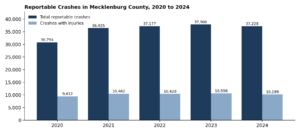
Source: North Carolina Department of Transportation, 2024 Mecklenburg County Crash Profile.
Worried the insurance company will try to blame you for the crash?
Attorney Kyle T. Watson spent years practicing insurance defense before representing injured people, so he knows the arguments adjusters use to shift fault in rear-end cases and how to answer them. Call (704) 885-5025 for a free consultation.
Frequently Asked Questions About Rear-End Accidents in Charlotte
Is the driver who rear-ends me automatically at fault in North Carolina?
Not automatically. The rear driver is usually found responsible because North Carolina law requires drivers to keep a safe following distance, but the insurance company can still argue that you contributed to the crash. Because North Carolina follows contributory negligence, that argument matters more here than in most states.
Do I have to report a minor rear-end accident in Charlotte?
North Carolina law requires you to report any crash that causes injury, death, or at least $1,000 in property damage. Even a low-speed rear-end impact can cause $1,000 in bumper and sensor damage, so calling CMPD from the scene is usually the safest choice.
Why do my neck and back hurt more days after being rear-ended?
Rear-end impacts snap the head backward and forward, and soft tissue injuries like whiplash often take hours or days to fully show up. See a doctor as soon as symptoms appear and tell them you were in a rear-end collision.
Should I give a recorded statement to the other driver’s insurance company?
You are not required to give the at-fault driver’s insurer a recorded statement. Adjusters use these statements to look for anything that suggests you were partly at fault. Speak with an attorney before agreeing to one.
How long do I have to file a claim after a rear-end accident in North Carolina?
In most cases, you have three years from the date of the crash to file a personal injury lawsuit in North Carolina. Waiting that long is risky, though, because evidence such as video footage and witness memories can disappear within days or weeks.
What if the driver who hit me does not have enough insurance?
North Carolina requires drivers to carry at least $50,000 per person in bodily injury coverage for policies issued or renewed since July 1, 2025. If your injuries exceed the other driver’s limits, your own underinsured motorist coverage may help cover the difference.
What Happens When You Call The Watson Law Office
When you call (704) 885-5025, a member of our team will ask a few basic questions about the crash, including when and where it happened, whether you were injured, and whether you have spoken with any insurance company. We will set up a free consultation with Attorney Kyle T. Watson, who will review your crash report, photos, and medical treatment so far. You will leave with a clear understanding of whether you have a claim, what it may be worth, and what to do next to protect it.
Talk to a Charlotte Rear-End Accident Lawyer
The Watson Law Office, PLLC represents people injured in rear-end collisions and other personal injury cases throughout Charlotte and the Carolinas. Attorney Kyle T. Watson is licensed in both North Carolina and South Carolina and brings an insurance defense background to every case he handles for injured clients. If you were rear-ended, do not let the insurance company decide your claim before you understand it.
Call (704) 885-5025 or contact us online for a free consultation. The Watson Law Office, PLLC, 301 McCullough Drive, Suite 400, Charlotte, NC 28262.
