



North Carolina follows pure contributory negligence, one of the country’s harshest fault rules. If an insurance company can prove you were even 1% responsible for your injury, you can lose the right to recover anything, no matter how careless the other party was. Exceptions such as last clear chance and gross negligence can preserve a claim, which is why your case facts matter so much.
Most states divide fault between the people involved in an accident and reduce compensation accordingly. North Carolina does not. That single difference shapes how insurers investigate claims, what they ask you in a recorded statement, and how much leverage you have when negotiating a settlement in Charlotte.
What Contributory Negligence Means in North Carolina
Contributory negligence is a defense. It argues that the injured person failed to use reasonable care for their own safety and that this failure helped cause the injury. In North Carolina, a successful contributory negligence defense does not reduce your recovery. It eliminates it.
The rule comes from more than a century of North Carolina court decisions, not a single statute. However, the legislature has addressed who must prove it. Under N.C. Gen. Stat. 1-139, the defendant must prove contributory negligence. You do not have to prove you were perfectly careful. The other side has to prove you were not.
How North Carolina Compares to the Rest of the Country
Only North Carolina, Virginia, Maryland, Alabama, and Washington, D.C. still follow pure contributory negligence. Nearly every other state uses some form of comparative fault, which reduces compensation by the injured person’s share of responsibility rather than eliminating it.
For Charlotte residents, the most important comparison sits just a few miles south. South Carolina uses modified comparative fault. An injured person can recover as long as their fault is not greater than the other party’s, with the award reduced by their percentage of responsibility. The chart below shows how the same $100,000 claim plays out under each state’s rule.
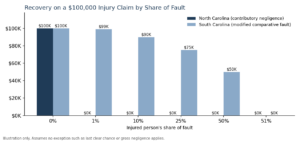
At one percent fault, a South Carolina claimant would recover $99,000. In North Carolina, the same person may recover nothing. Many people commute between Charlotte, Fort Mill, and Rock Hill every day, so where a crash happens can decide whether a claim survives at all.
How Insurance Companies Use the One Percent Rule
Because any fault on your part can end a North Carolina claim, insurers have a strong incentive to find some. Common arguments include:
- Speed. Claiming you were driving a few miles over the limit, even when the other driver ran a red light.
- Distraction. Requesting phone records or asking whether you glanced at a navigation screen.
- Failure to keep a lookout. Arguing you should have seen the other vehicle, cyclist, or hazard sooner.
- Pedestrian choices. Pointing out that a pedestrian crossed outside a crosswalk or against a signal.
- Your own words. Using an apology or casual statement at the scene, or a recorded statement given to the adjuster, as an admission of fault.
Adjusters often call within days of an accident and ask friendly questions that are designed to uncover one of these points. Speaking with a lawyer before giving any recorded statement is one of the simplest ways to protect a North Carolina claim.
Mecklenburg County roads give insurers plenty of chances to make these arguments. According to the NCDOT 2024 Mecklenburg County Crash Profile, the county recorded 37,228 reportable crashes in 2024, which produced 16,978 injuries and 147 deaths. Our Charlotte car accident page covers how fault is established in the most common crash types.
Exceptions That Can Save a Claim
Contributory negligence is harsh, but it is not absolute. North Carolina recognizes several doctrines that allow an injured person to recover even after making a mistake.
The Last Clear Chance Doctrine
Last clear chance applies when the injured person’s negligence puts them in a position of danger they cannot escape, and the other party sees or should have seen that danger in time to avoid the harm but fails to do so. In that situation, the defendant’s failure to use the last clear chance becomes the deciding cause, and contributory negligence does not bar the claim.
This doctrine often comes up in pedestrian cases and in crashes where a driver had time to brake or swerve but did not. Proving it usually requires detailed evidence about timing, distance, and visibility.
Gross Negligence or Willful Conduct
Ordinary contributory negligence is not a defense when the defendant acted with gross negligence, meaning willful or wanton conduct that shows a conscious disregard for others’ safety. Extreme speeding, street racing, and some drunk driving cases may fall into this category.
Young Children
North Carolina presumes that a child under seven cannot be contributorily negligent. Children between seven and fourteen are presumed incapable, but the defense can try to rebut that presumption. Courts judge older teens by what a reasonable child of the same age, experience, and capacity would have done.
The Seat Belt Rule
Insurers cannot use a missing seat belt to defeat your claim. Under N.C. Gen. Stat. 20-135.2A, evidence that you were not wearing a seat belt is generally inadmissible in a civil case.
Rule or Exception | What It Requires | Effect on Your Claim |
|---|---|---|
Pure contributory negligence | Defendant proves you failed to use reasonable care and that it helped cause the injury | Recovery is barred entirely |
Last clear chance | Defendant had time and means to avoid harm after you were in helpless peril | Contributory negligence no longer bars recovery |
Gross negligence | Defendant acted willfully, wantonly, or with conscious disregard for safety | Ordinary contributory negligence is not a defense |
Child under seven | Injured child was younger than seven | Child cannot be found contributorily negligent |
Seat belt evidence | Insurer tries to use failure to buckle up | Evidence is generally inadmissible |
Why Evidence Matters More in North Carolina
Because the defense only needs a small amount of fault, the strength of your evidence often decides the case. North Carolina courts generally treat contributory negligence as a jury question and only take it away when the evidence of fault is so clear that no other reasonable conclusion exists. Building a record that leaves room for reasonable doubt about your fault is often what keeps a claim alive.
Useful evidence includes dashcam and traffic camera video, nearby business surveillance footage, the officer’s crash report and diagram, witness statements, vehicle event data, and photos of road conditions and sight lines. Much of this disappears within days or weeks, especially video that is recorded over on a set schedule.
Motorcycle riders face these arguments more often than most, since insurers frequently claim a rider was speeding or hard to see. Our Charlotte motorcycle accident page explains how those claims are defended.
Has an insurance adjuster suggested the accident was partly your fault? The Watson Law Office represents injured people throughout Charlotte and Mecklenburg County. Call (704) 885-5025 before you give a recorded statement.
Frequently Asked Questions About North Carolina Contributory Negligence
Is North Carolina a contributory negligence state?
Yes. North Carolina is one of only a handful of jurisdictions, along with Virginia, Maryland, Alabama, and Washington, D.C., that still follow pure contributory negligence. If you are found even slightly at fault for your own injury, you generally cannot recover damages from the other party.
Is there a North Carolina contributory negligence statute?
The rule itself comes from North Carolina case law rather than a single statute. However, N.C. Gen. Stat. 1-139 places the burden of proving contributory negligence on the defendant, which means the insurance company or defense attorney must prove your fault rather than you having to disprove it.
Can I still recover if I was partly at fault in North Carolina?
Sometimes. The last clear chance doctrine, a defendant’s gross negligence or willful conduct, and special rules for young children can all allow a recovery even when the injured person made a mistake. Whether an exception applies depends heavily on the facts.
Does not wearing a seat belt count as contributory negligence in North Carolina?
No. Under N.C. Gen. Stat. 20-135.2A, evidence that you were not wearing a seat belt is generally not admissible in a civil case, so an insurer cannot use it to argue that you contributed to your own injuries.
What if my accident happened in South Carolina?
South Carolina uses modified comparative fault. You can recover as long as your share of fault is not greater than the other driver’s, and your award is reduced by your percentage of fault. For Charlotte residents injured across the state line, where the crash happened can change the outcome.
What Happens When You Call The Watson Law Office
When you call (704) 885-5025, our team will ask how the accident happened, where it took place, whether police responded, and whether an insurance company has already contacted you. Attorney Kyle T. Watson will review the facts and explain whether contributory negligence is likely to be raised in your case, which exceptions may apply, and what evidence to preserve right away.
Talk to a Charlotte Personal Injury Lawyer
In North Carolina, the difference between full compensation and nothing can come down to how one percent of fault is argued. If you were hurt in an accident and the other side is pointing back at you, learn more about how our Charlotte personal injury lawyers handle these claims, then call to discuss your options.
Call The Watson Law Office, PLLC at (704) 885-5025. 301 McCullough Drive, Suite 400, Charlotte, NC 28262.
