



In North Carolina, most personal injury claims must be filed within three years of the date of injury under N.C. Gen. Stat. 1-52(16). Some claims have shorter deadlines, including two years for wrongful death and one year for assault and battery. Medical malpractice, product defect, and latent injury claims also face outer time limits that can bar a case even when the injury is discovered late.
The statute of limitations is the legal deadline for filing a lawsuit. Missing it usually ends a claim permanently, regardless of how serious the injury or how clear the other party’s fault. Knowing which deadline applies, and when the clock starts, is one of the first things to settle after any injury in Charlotte.
The General Three-Year Rule
North Carolina gives injured people three years to file most negligence claims, including car accidents, truck crashes, slip-and-fall injuries, dog bites, and other premises injuries. Property damage claims, such as vehicle repair costs, also have a three-year deadline under G.S. 1-52(4).
The deadline is for filing a lawsuit in court, not for reporting the claim to an insurance company. Many people assume an open insurance claim keeps their rights alive. It does not. An adjuster can continue negotiating right up to the deadline and then stop returning calls once it passes.
For car accident claims, our Charlotte car accident page explains what happens between the crash and filing a lawsuit.
Deadlines by Type of Claim
The three-year rule has several important exceptions. The chart below shows the most common deadlines and outer limits for injury claims in North Carolina.
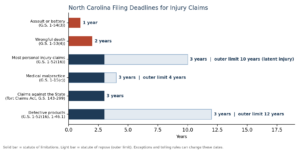
Type of Claim | Deadline | Key Statute and Notes |
|---|---|---|
Most personal injury claims | 3 years | G.S. 1-52(16); starts when injury becomes apparent, 10-year outer limit |
Vehicle and property damage | 3 years | G.S. 1-52(4) |
Wrongful death | 2 years from death | G.S. 1-53(4) |
Assault and battery | 1 year | G.S. 1-54(3) |
Medical malpractice | 3 years from last act | G.S. 1-15(c); discovery rule allows up to 4 years |
Defective products | 3 years | G.S. 1-52(16); no claim more than 12 years after initial purchase under G.S. 1-46.1 |
Claims against the State of North Carolina | 3 years | Filed with the Industrial Commission under G.S. 143-299 |
When the Clock Starts
For most injuries, the clock starts on the day of the accident. North Carolina also recognizes that some injuries are not obvious right away. Under G.S. 1-52(16), a personal injury claim does not accrue until the bodily harm becomes apparent or reasonably should have become apparent.
That discovery rule has a hard stop. A latent injury claim generally cannot be filed more than 10 years after the last act or omission of the defendant that caused it. North Carolina courts have held that this outer limit does not apply to latent diseases in the same way, which is a fact-specific issue worth reviewing with a lawyer.
Medical Malpractice
Medical malpractice claims run from the date of the provider’s last act, not the date of the bad outcome. Under G.S. 1-15(c), the general deadline is three years. If the injury was not readily apparent, a patient may have one year from discovery, but never more than four years from the last act. A foreign object left in the body has a separate rule allowing one year from discovery, up to 10 years.
Wrongful Death
A wrongful death action must be filed within two years of the date of death. The personal representative of the estate brings the claim, which means an estate often must be opened first. That step takes time, so families should not wait until the second year to begin.
Exceptions That Can Pause or Extend the Deadline
Injured Children
Under G.S. 1-17, the statute of limitations is generally paused while the injured person is under 18. In most cases, a child injured in North Carolina has until age 21 to file. Parents should still act early, because evidence fades and a parent’s own claim for the child’s medical expenses may follow a different timeline.
Legal Incompetence
The same statute pauses the deadline for a person who is legally incompetent when the claim arises. Once a guardian is appointed or competence is restored, the clock generally starts running.
Voluntary Dismissal and Refiling
If a lawsuit is filed on time and later voluntarily dismissed without prejudice under Rule 41(a) of the North Carolina Rules of Civil Procedure, the plaintiff generally has one year to refile, even if the original deadline has passed. This rule is often used strategically, but it works only if the first case was filed within the statute of limitations.
Worried an injury deadline may be close? The Watson Law Office represents injured people throughout Charlotte and Mecklenburg County. Call (704) 885-5025 to review your timeline before it runs out.
Charlotte Injuries That Cross the State Line
Many Charlotte residents work, shop, and drive in South Carolina. South Carolina also uses a three-year deadline for most personal injury claims, but claims against South Carolina government entities generally must be filed within two years under the South Carolina Tort Claims Act. The rules on fault differ even more sharply. North Carolina’s contributory negligence rule can bar a claim over even one percent of fault, while South Carolina uses modified comparative fault.
Where an accident happened, where the defendant lives, and which state’s law applies can all affect the deadline and the outcome. These questions should be answered early, while every option is still open.
Why Waiting Hurts a Claim Even Before the Deadline
Three years sounds like plenty of time. In practice, waiting creates problems long before the deadline arrives. Surveillance video is often recorded over within days. Witnesses move or forget details. Vehicles are repaired or sold, and the data stored in their event recorders is lost.
Insurance companies also tend to treat a long gap between the accident and medical treatment as evidence that the injury was minor. Moving promptly protects both the deadline and the value of the claim. Our Charlotte personal injury overview explains how we build a claim from the first days after an accident.
Frequently Asked Questions About North Carolina Injury Deadlines
What is the statute of limitations for personal injury in North Carolina?
Most personal injury claims in North Carolina must be filed within three years under N.C. Gen. Stat. 1-52(16). The clock usually starts on the date of the injury, or when the injury became apparent or reasonably should have become apparent.
Is the deadline different for a car accident in North Carolina?
No. Car accident injury claims generally follow the same three-year deadline, and property damage claims for your vehicle also have three years under G.S. 1-52(4). If someone died in the crash, the wrongful death claim has a shorter two-year deadline.
How long does a minor have to file a personal injury claim in North Carolina?
Under G.S. 1-17, the statute of limitations is generally paused until a child turns 18, giving them until age 21 to file most injury claims. Medical malpractice claims involving minors follow special rules, and a parent’s own claim for the child’s medical bills may have a separate deadline.
Does negotiating with the insurance company stop the statute of limitations?
No. Settlement talks, recorded statements, and claim numbers do not pause the deadline. Only filing a lawsuit, or a written agreement that complies with the law, protects the claim once time runs short.
What happens if I miss the North Carolina statute of limitations?
The defendant can ask the court to dismiss the case, and the court will almost always grant that request. Once the deadline passes, the insurance company also has little reason to offer a settlement.
What Happens When You Call The Watson Law Office
When you call (704) 885-5025, our team will ask the date of the injury, how it happened, whether anyone died, and whether a government vehicle or property was involved. Attorney Kyle T. Watson will identify the applicable deadline, confirm how much time remains, and explain what you need to do next to protect your claim.
Talk to a Charlotte Personal Injury Lawyer Before Time Runs Out
A missed deadline is one of the few mistakes in a personal injury case that usually cannot be fixed. If you were hurt in North Carolina and are unsure how much time you have, the safest step is to find out now.
Call The Watson Law Office, PLLC at (704) 885-5025. 301 McCullough Drive, Suite 400, Charlotte, NC 28262.
